
Travis County Probate Courts
Travis County has two statutory probate courts, both at 200 W. 8th Street in downtown Austin. Probate Court No. 1 is led by the Honorable Guy Herman, and Probate Court No. 2 by the Honorable Nicholas Chu. These are dedicated probate courts, not a division of a general district court, which is unusual and means probate has its own bench and its own local rules. The County Clerk Probate Division supports both courts and keeps the records.
The Travis County Probate Court page describes the courts, the local rules, and the filing procedures.
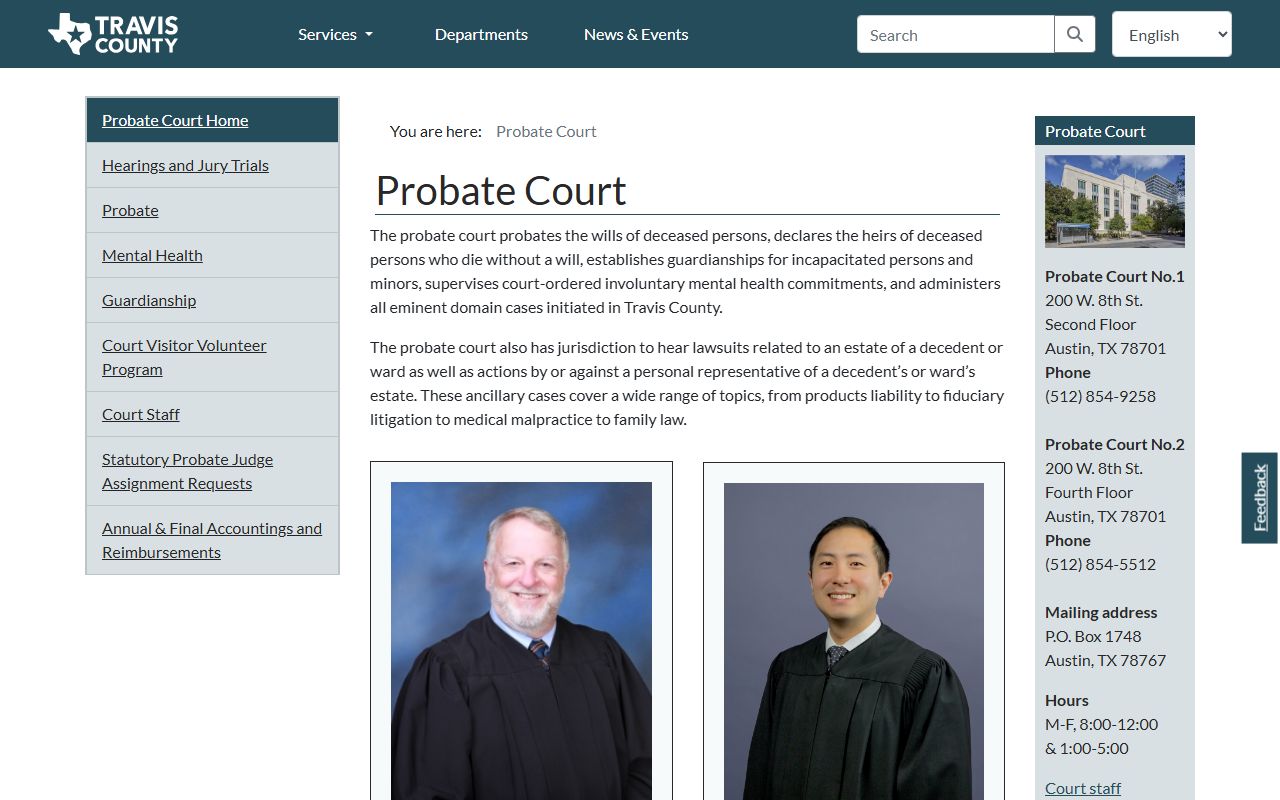
The two courts share an address and a clerk division, so a filing or a copy request goes to the same place regardless of which judge hears the case. Having two dedicated probate benches also means the county can move a heavy probate and guardianship caseload without forcing those matters to compete with criminal and civil trials for court time.
Probate Court No. 1
Judge: Hon. Guy Herman
200 W. 8th Street
Austin, TX 78701
512-854-5958
Probate Court No. 2
Judge: Hon. Nicholas Chu
200 W. 8th Street
Austin, TX 78701
512-854-5958
What Probate Covers in Travis County
Probate is broader than wills. The Travis County probate courts probate wills, declare heirs for people who die without a will, establish guardianships for incapacitated adults and minors, supervise court-ordered involuntary mental-health commitments, and administer eminent-domain cases filed in the county. The courts also hear lawsuits tied to an estate or a ward, including fiduciary, medical-malpractice, and certain family-law matters connected to those cases.
Because probate uses precise legal terms, a few definitions help before you search or file.
- Testator
- The person who made a will.
- Executor
- The person a will names to settle the estate.
- Intestate
- Dying without a valid will, which triggers an heirship proceeding.
- Guardianship
- A court arrangement to care for a minor or an incapacitated person.
- Conservatorship
- Court authority to manage another person's property or affairs.
How to Search Probate Records in Odyssey
Probate case data and documents are searched in the Travis County Odyssey Portal, the same system used for civil and criminal records. Open Smart Search, then use the Advanced Filtering Options to select the Probate Court location so your results focus on probate cases. You can search by a party name, such as a decedent or applicant, or by a cause number. County Clerk records guidance says probate case data is online from July 1992, and redacted probate documents are online from November 2009.
Older estates may show an index entry with no scanned image attached, which means the file exists but the documents are not online. For those, request copies from the County Clerk Probate Division. The Probate Court page also links re:SearchTX for Texas court records and eFileTexas for electronic filing. For the full portal walkthrough, see the court records page, and for hearing dates, see court dockets.
Probate Filing Fees in Travis County
The County Clerk publishes a probate fee schedule, and most major applications share a common base fee. Credit-card payments add a fee of $3 under $100 or 3 percent at $100 and up, and fax filing is not accepted. The County Clerk probate fee page lists the full schedule and payment methods.
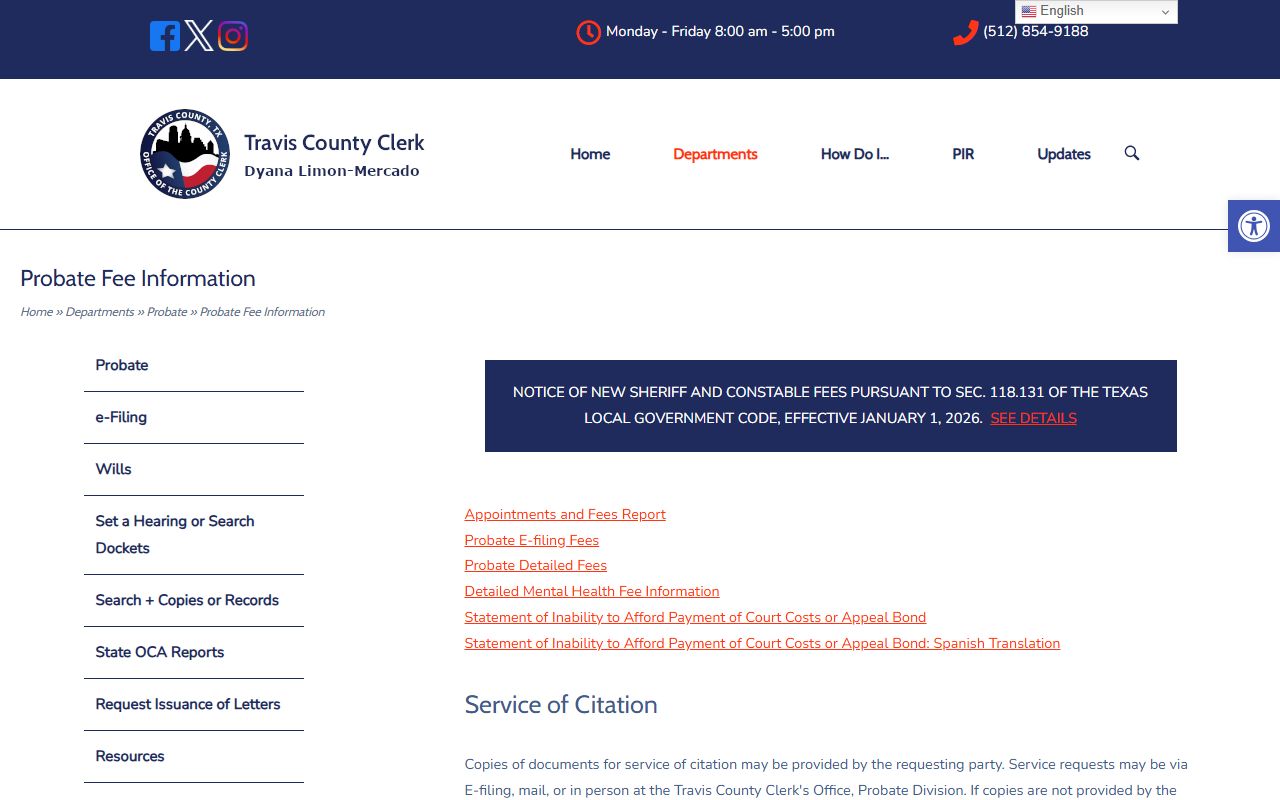
The common probate charges are below.
| Item | Fee |
|---|---|
| Probate of will and letters testamentary | $360 |
| Application to appoint administrator | $360 |
| Application for guardianship | $360 |
| Determination of heirship | $360 |
| Small estate affidavit | $360 |
| Will for deposit during lifetime | $5 |
| Certified copies | $5 per document plus copy cost |
A lost will, late probate, or ad litem deposit can add $525, and claims against an estate carry a smaller fee. Letters testamentary or of guardianship cost $2 each.
Will Deposit and Letters
Texas lets a person deposit a will with the County Clerk during their lifetime for safekeeping, and the Travis County local fee for that deposit is $5. After a court admits a will or appoints a representative, the clerk issues letters, which are the documents that prove a person's authority to act for an estate or a ward. Letters testamentary go to an executor, letters of administration to an administrator, and letters of guardianship to a guardian.
These letters matter in the real world, because banks, title companies, and other institutions ask to see them before they let a representative act. A certified copy of the letters, ordered from the County Clerk, is what those institutions usually require. The probate fee schedule lists letters at $2 each and exemplified letters at $4.
Guardianship and Mental Health Records
Guardianship and mental-health matters are the most sensitive part of the probate docket. The probate courts establish guardianships for incapacitated adults and minors and supervise court-ordered involuntary mental-health commitments. These records carry strong privacy protections, and they are not browsed like a routine estate file. Medical information and a ward's personal details may be restricted.
The Probate Court No. 1 page lists the court staff and contacts for these matters. The Probate Court No. 1 page identifies the judge, associate judge, coordinator, and other staff.
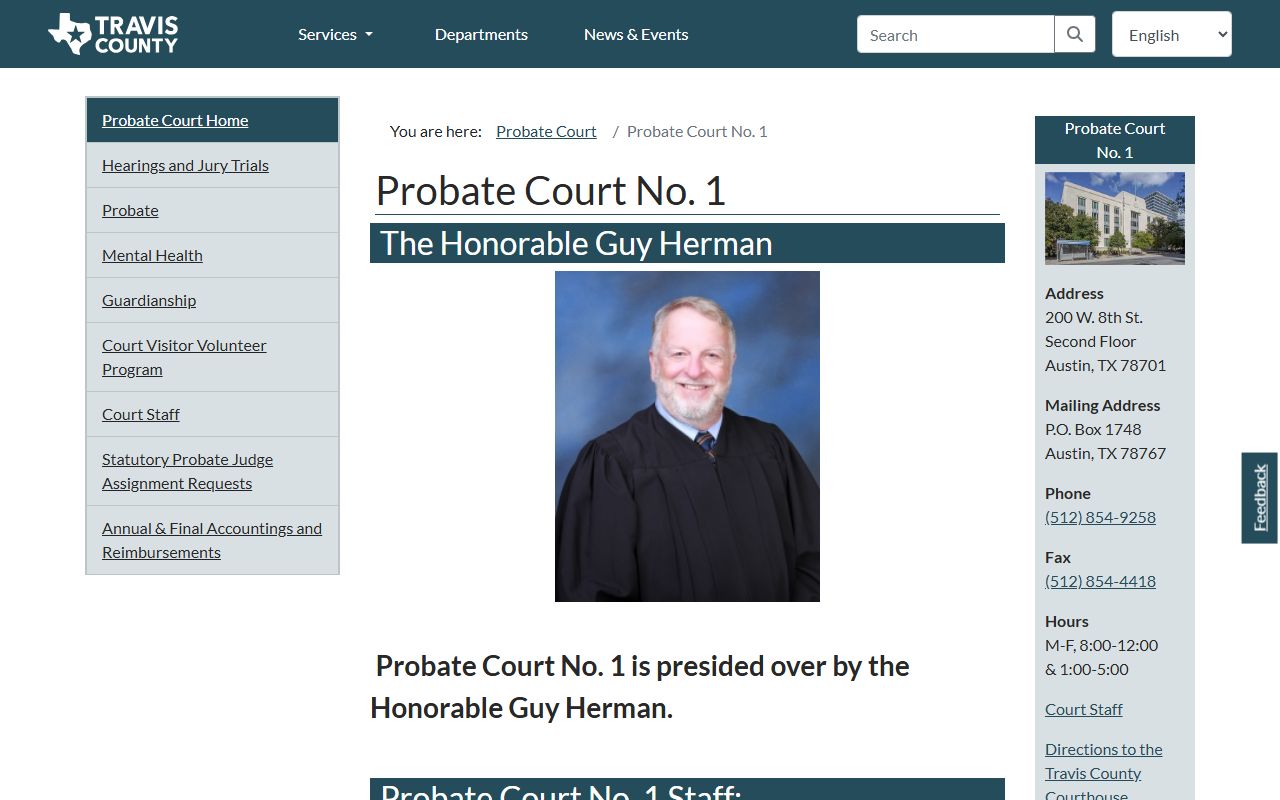
Because guardianship affects a person's rights, the court holds applicants to careful procedures and often expects an attorney to be involved.
Payment Methods and E-Filing
The County Clerk Probate Division accepts a range of payments, which matters when a filing fee or copy charge is due. The options include cash, personal and business checks, money orders, cashier's checks, LegalEase, and the major credit cards, Visa, MasterCard, Discover, and American Express. The credit-card transaction fee is $3 for amounts under $100 or 3 percent for amounts of $100 or more. Fax filing is not accepted, so plan to file electronically, in person, or by mail.
Attorneys must e-file in Texas, and pro se filers may e-file as well, through eFileTexas. The Probate Court links eFileTexas for filing, the Odyssey Portal for case data and documents, and re:SearchTX for Texas court records. Service and citation requests must be made in writing, with names, addresses, and the type of citation, and they can be e-filed with fees added in the additional-services section or requested in person. The court also publishes local rules, an uncontested guardianship docket procedure, an auditor handout, and a pro se applicant policy, with an attorney's-fees-in-probate update effective April 1, 2026. These resources sit on the Probate Court page and help filers follow the right procedure the first time.
How Probate Works in Travis County
Opening an estate follows a defined path. The steps below outline a typical Travis County probate case, though the details vary by whether there is a will and whether administration is needed.
- Determine whether the decedent left a will and whether administration is necessary.
- File the application in a Travis County Probate Court through eFileTexas, or in person or by mail.
- Pay the filing fee or submit a statement of inability to pay if eligible.
- The clerk issues citation or notice; the applicant provides service copies if required.
- The court sets a hearing, often on the uncontested docket if eligible.
- The judge signs an order admitting the will, appointing a representative, or determining heirship.
- The clerk issues letters after any required oath or bond.
- The representative files an inventory, handles claims, and files annual or final accounts as required.
Filing Probate Without a Lawyer
The probate courts have a court policy for pro se applicants, but Texas probate often requires an attorney when a person acts for an estate. The reason is that an executor or administrator represents the interests of beneficiaries and creditors, not only themselves, and Texas treats that as the practice of law. A person can represent only their own interests, so acting for others usually means hiring counsel.
Before assuming you can file alone, read the court's pro se policy or consult an attorney. The Travis County Law Library and Texas Law Help can point you to forms and basic instructions, but they do not give legal advice or file for you. For marriage and divorce records that sometimes intersect with estate matters, see marriage and divorce records. A small estate affidavit or a muniment of title can be a simpler path for a modest estate, but each still has rules, so confirm eligibility before choosing it over full administration.