
How to Use Travis County Criminal Databases
Start with the county, then widen out. The Travis County Odyssey portal and the Sheriff's jail roster cover local cases and current custody. For a person sent to state prison, the Texas Department of Criminal Justice keeps the record. For a registered offender, the Department of Public Safety runs a public registry. For a federal case, the Bureau of Prisons keeps the inmate record. Each system is free and searchable by name.
These databases answer different questions, so pick the one that fits. A county search will not show a state prisoner, and a state search will not show someone still in the county jail awaiting trial. For local custody, begin at Travis County inmate records.
It helps to picture the path a case can take. A person arrested in Travis County first appears in the county jail roster. If the charge is dismissed or the person bonds out, they leave that system. If convicted and sentenced to state prison, the record moves to the Texas Department of Criminal Justice. A federal charge follows a separate track into the Bureau of Prisons. A conviction for a registrable offense adds the person to the DPS sex-offender registry. Each step lands in a different database, so a full picture often means checking several tools, not just one. None of them is a substitute for the certified court record that the clerk holds.
TDCJ Offender Search for State Prison
When a Travis County defendant is sentenced to state prison, the file moves to the Texas Department of Criminal Justice. The TDCJ offender search is separate from the county jail and covers people in TDCJ custody, not county pretrial detainees. The TDCJ offender search accepts a name or a state ID number.
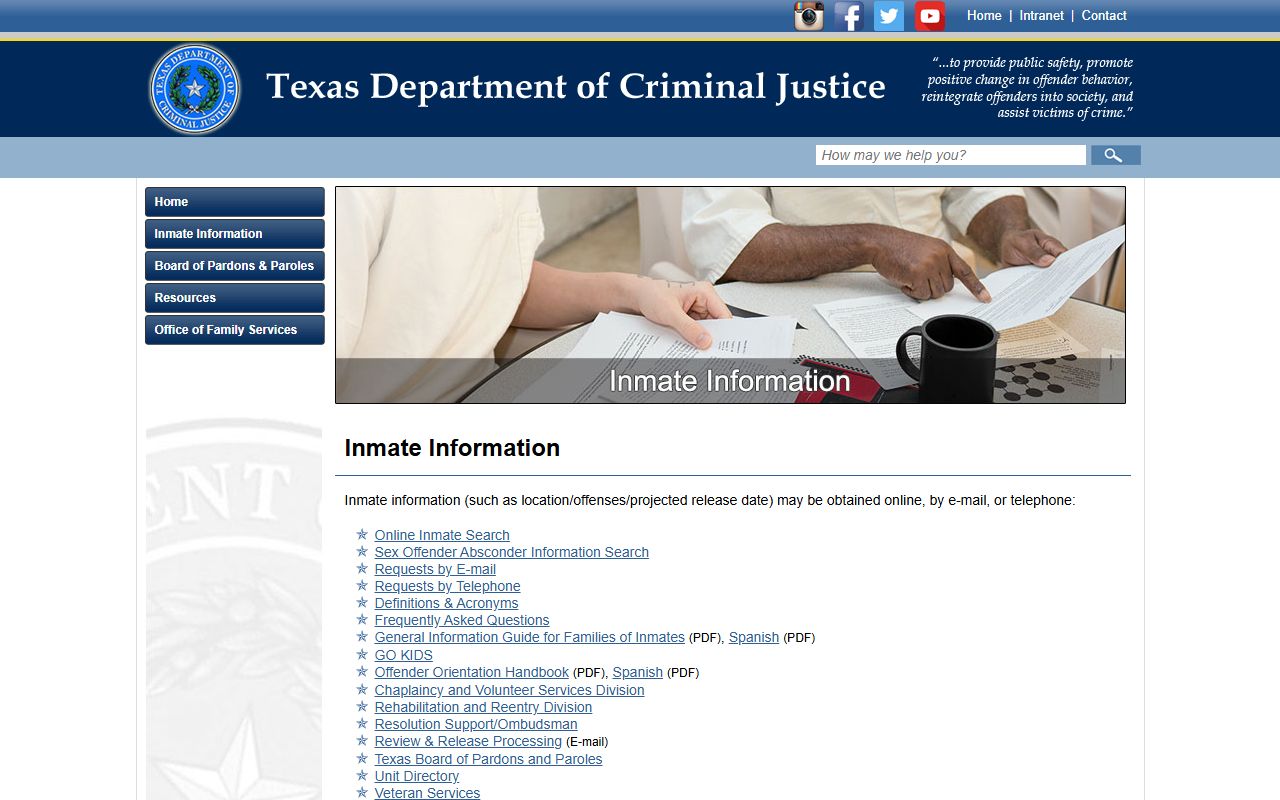
That tool returns the offender's facility, offense, and projected release. The search fields are below.
| Field Label | Type | Required | Notes |
|---|---|---|---|
| Last Name | Text | No | Use with a first name for a name search |
| First Name | Text | No | Narrows a common last name |
| TDCJ Number | Text | No | Direct search by TDCJ number |
| SID Number | Text | No | State identification number |
A result commonly shows the TDCJ number, name, race, gender, age, projected release date, current facility, offense, county of conviction, and sentence length. The county of conviction field is useful for confirming that a state prisoner's case began in Travis County. Keep in mind that a projected release date can move. State sentence credits and program completion can shift the date, so treat it as an estimate, not a promise. A person who just received a Travis County sentence may also take time to appear, because the transfer from the county jail to a state intake facility is not instant.
Texas DPS Sex Offender Registry
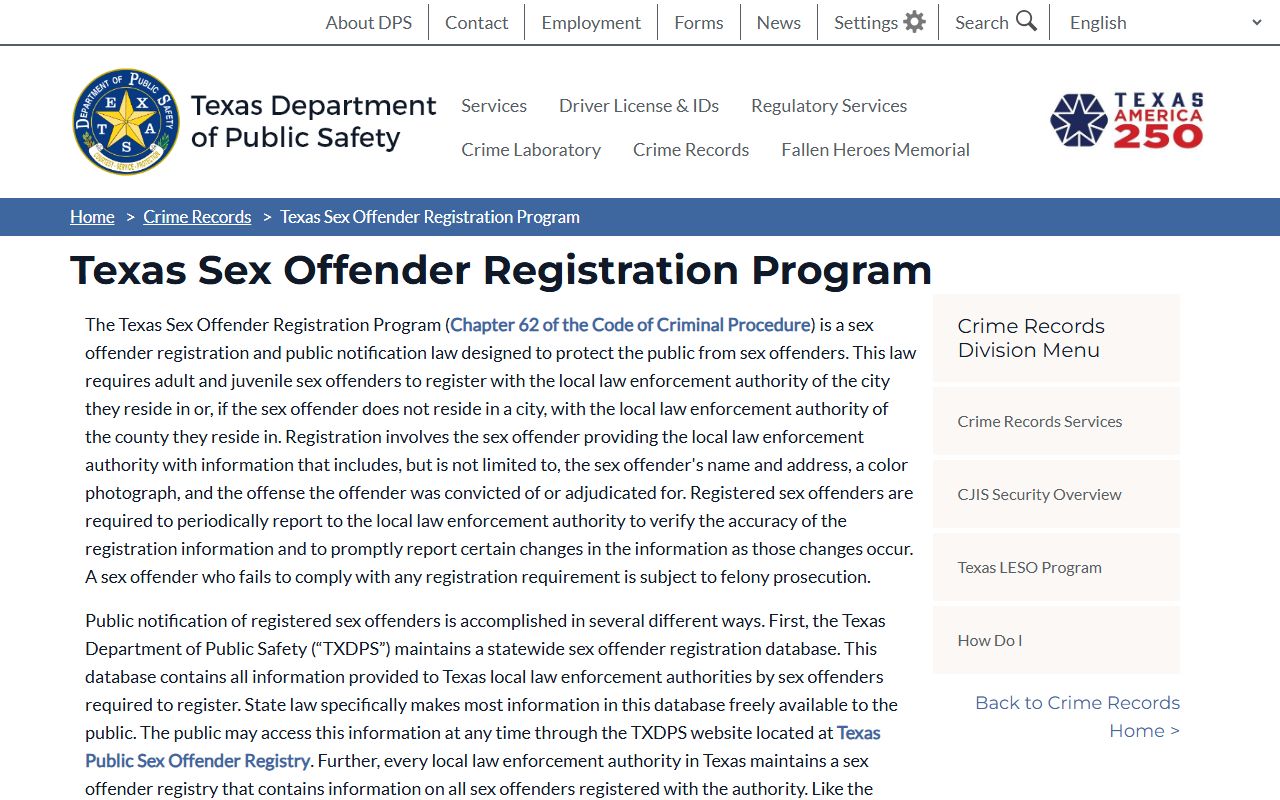
The Texas Department of Public Safety runs the public sex-offender registry under Code of Criminal Procedure Chapter 62. It supports search by name and by location, including a map and radius. DPS notes most registry information is public. The DPS sex-offender program page explains how registration and public notification work.
The public search site is separate from the program page. The DPS public sex-offender registry is where you run a name or address search.
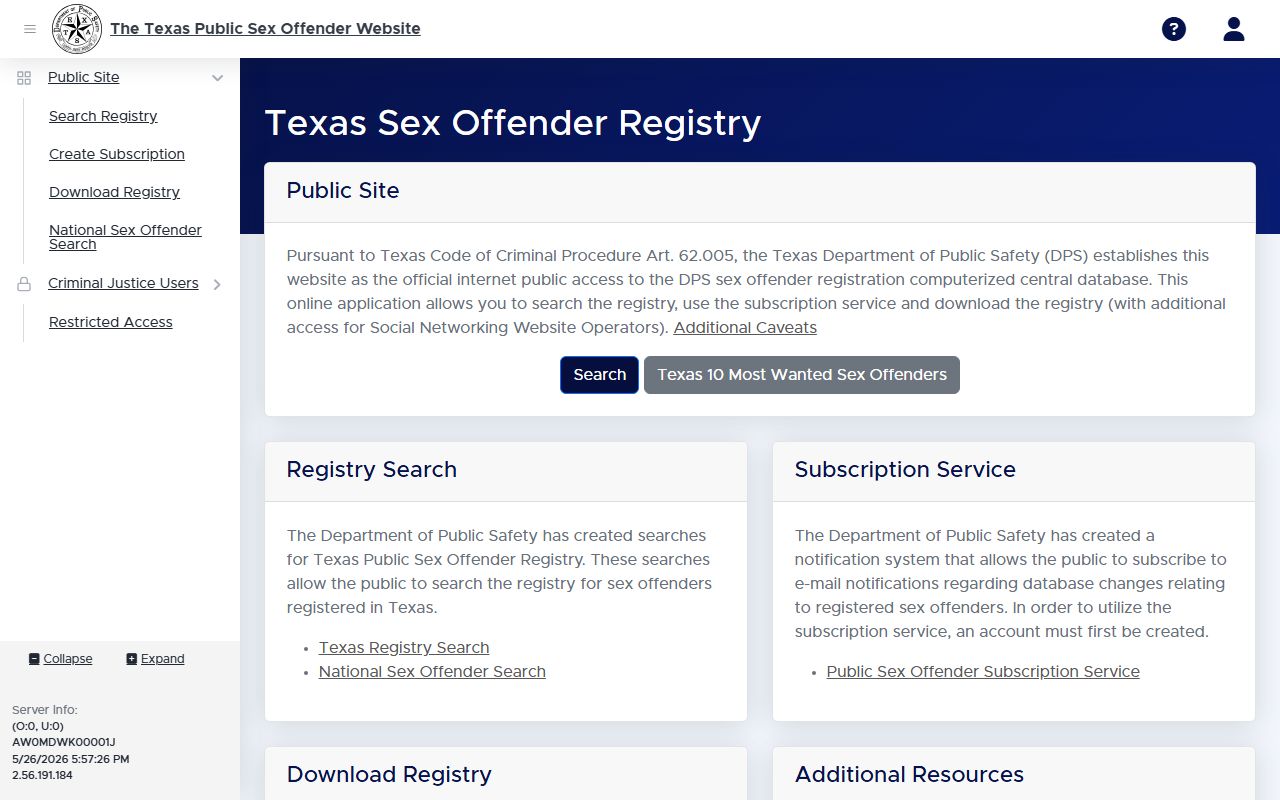
A registry profile may show name, aliases, a photo, address, county, offense, and registration status. DPS keeps some fields private.
| Field Label | Type | Required | Notes |
|---|---|---|---|
| Name | Text | No | Search by offender name |
| City / ZIP / County | Text | No | Location-based search |
| Map / radius | Map | No | Geographic search around an address |
Non-public fields include Social Security number, driver's license number, phone numbers, online identifiers, employer details, and victim-identifying information. The registry is built for public safety, not for harassment, and Texas law makes misuse of registry data its own offense. Use it to check an address or confirm a status, and remember that registration is a separate matter from the underlying Travis County conviction, which still lives in the court record held by the clerk.
Texas Criminal History Record Information
The DPS Crime Records Service keeps statewide criminal-history record information under Government Code Chapter 411. This is the formal state rap sheet, and access depends on who is asking and why. The public site offers a name-based conviction search for a fee, while licensed and government users get broader access. An order of nondisclosure restricts what shows here without destroying the record.
The Government Code Chapter 411 statute governs this system and the nondisclosure process. A Travis County conviction can appear in the state database even after a county case closes. This is why a person who wants a fresh start often needs more than a local fix. An expunction handled by the Travis County District Clerk removes qualifying records, and an order of nondisclosure restricts what the state database shares with the public. Both require a court process. Until an order is final and the agencies update their files, an old arrest or charge can still surface in a state-level check, which is one reason employers and applicants should confirm the current status of a record rather than trusting a single search.
Federal Criminal Databases
Federal cases sit outside the state systems entirely. Travis County is in the Austin Division of the U.S. District Court for the Western District of Texas, and federal inmates are found through the Bureau of Prisons inmate locator, which covers people held from 1982 to the present. Federal case files run through PACER and CM/ECF, not the county portal. A federal charge is a different track with its own prosecutor, the U.S. Attorney for the Western District of Texas, and its own appeals path to the Fifth Circuit. A Travis County resident can have a federal case and a separate state or county case at the same time, and neither database will show the other.
The Bureau of Prisons inmate locator searches by name or by a number such as a BOP register number, in the format five digits, a dash, and three digits. A result shows the name, register number, age, race, sex, release date, and location. A status of released or not in custody means the person left federal custody, though they may be on supervision or in another system. For the federal courthouse, PACER, and the locator, see the Travis County federal records page. For people released from any system, see released inmates.
VINELink Custody Notifications
VINELink is a free national tool that does two things. It lets you search participating custody records, and it lets you register for notifications when a person's custody status changes. For someone worried about a release, this is the most useful option because it pushes an alert rather than making you check a roster every day. You select the state and the agency context, find the person, then pick how you want to be told, such as by phone, email, text, or app.
VINELink is a notification service, not an official court record, and it depends on the agencies that feed it. Use it alongside the county jail roster, not in place of it. A victim or a concerned family member can register quietly, and the alert arrives when the status changes. For the county-side release picture and the steps to verify a release in person, the released inmates page covers the full process.
What These Databases Do Not Show
Each database has blind spots, and trusting one alone leads to mistakes. The TDCJ search misses county jail detainees. The county jail roster misses state and federal prisoners. The sex-offender registry hides protected personal data. None of these tools is a certified court record.
Juvenile records stay confidential under Family Code Chapter 58. Expunged records should not appear at all, and nondisclosed records are hidden from the public. For an official record of a Travis County case, request a certified copy from the District Clerk or County Clerk.
Timing is the other common trap. Each database updates on its own schedule, so the same person can look one way in the county roster and another way in a state tool on the same day. A recent arrest may not have reached the state yet, and a recent release may not have cleared a database that still lists the person as in custody. When the answer matters for a legal, safety, or hiring decision, confirm it against the source that controls the record, whether that is the clerk, the Sheriff, TDCJ, or DPS, rather than relying on a screen capture from one search.