
About the Travis County District Clerk
The Travis County District Clerk maintains the official record of all court proceedings heard in the District Courts, plus some cases in County Court at Law 4. The office is the custodian of district-court files, the manager of jury service for several court types, and a passport acceptance agency. It collects fees, fines, and court costs, and it prepares judgments and appeal records for the district courts. The District Clerk about page describes the full scope of duties.
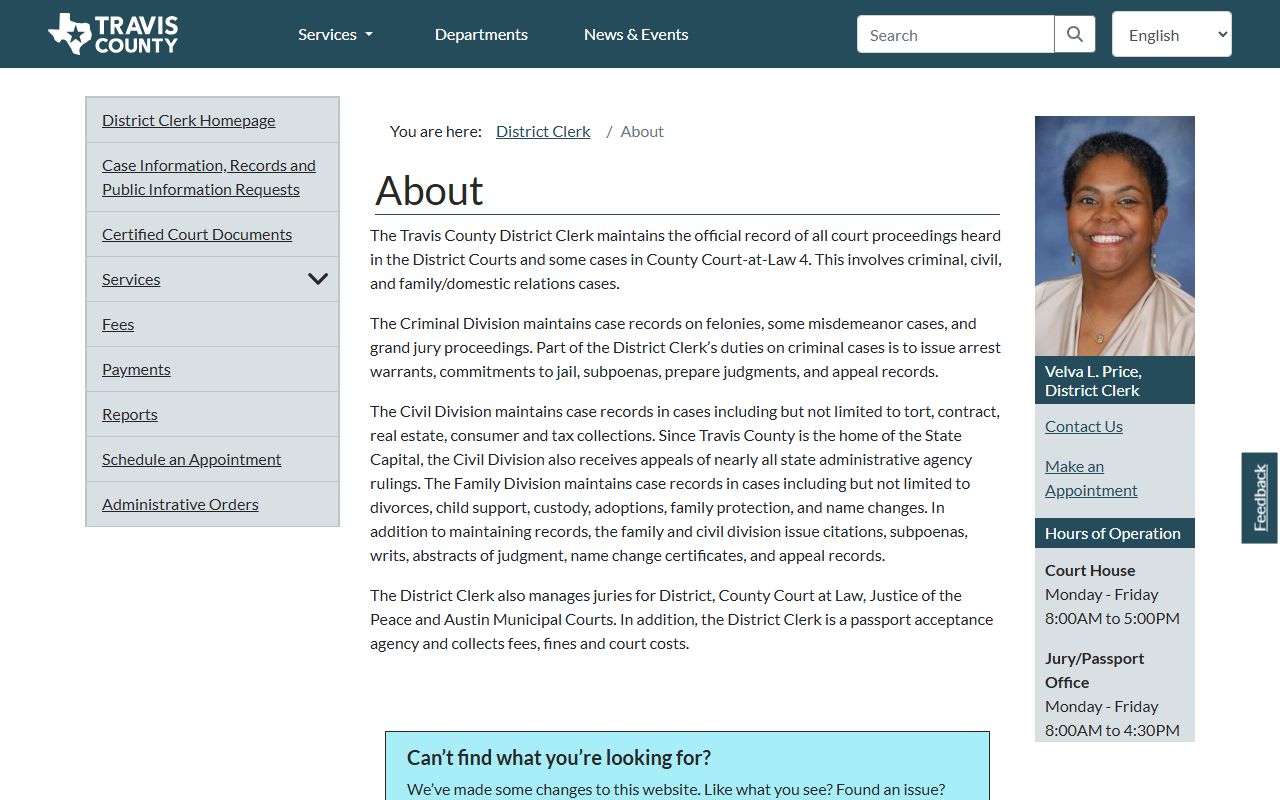
That page lays out the office's role across criminal, civil, family, and jury functions. Civil and family records are based at the Civil and Family Courts Facility, while felony records sit at the Gault Annex.
Travis County District Clerk
Civil and Family Records, Room 3.200
1700 Guadalupe Street
Austin, TX 78701
512-854-9457
Mon-Fri 8:00 AM-4:30 PM
What the District Clerk Does in Travis County
The District Clerk does far more than file paperwork. It keeps the record for every district-court case, issues process such as warrants and subpoenas in criminal matters, and prepares the records that go up on appeal. It also runs jury operations for the district courts, the county courts at law, the justice courts, and the Austin Municipal Court. The office's main duties include the following.
- Maintain district-court criminal, civil, and family case records.
- Issue arrest warrants, commitments, and subpoenas in criminal cases.
- Keep all felony expunctions and felony nondisclosures.
- Manage jury service for several court types.
- Act as a passport acceptance agency.
- Collect fees, fines, and court costs.
District Clerk Divisions
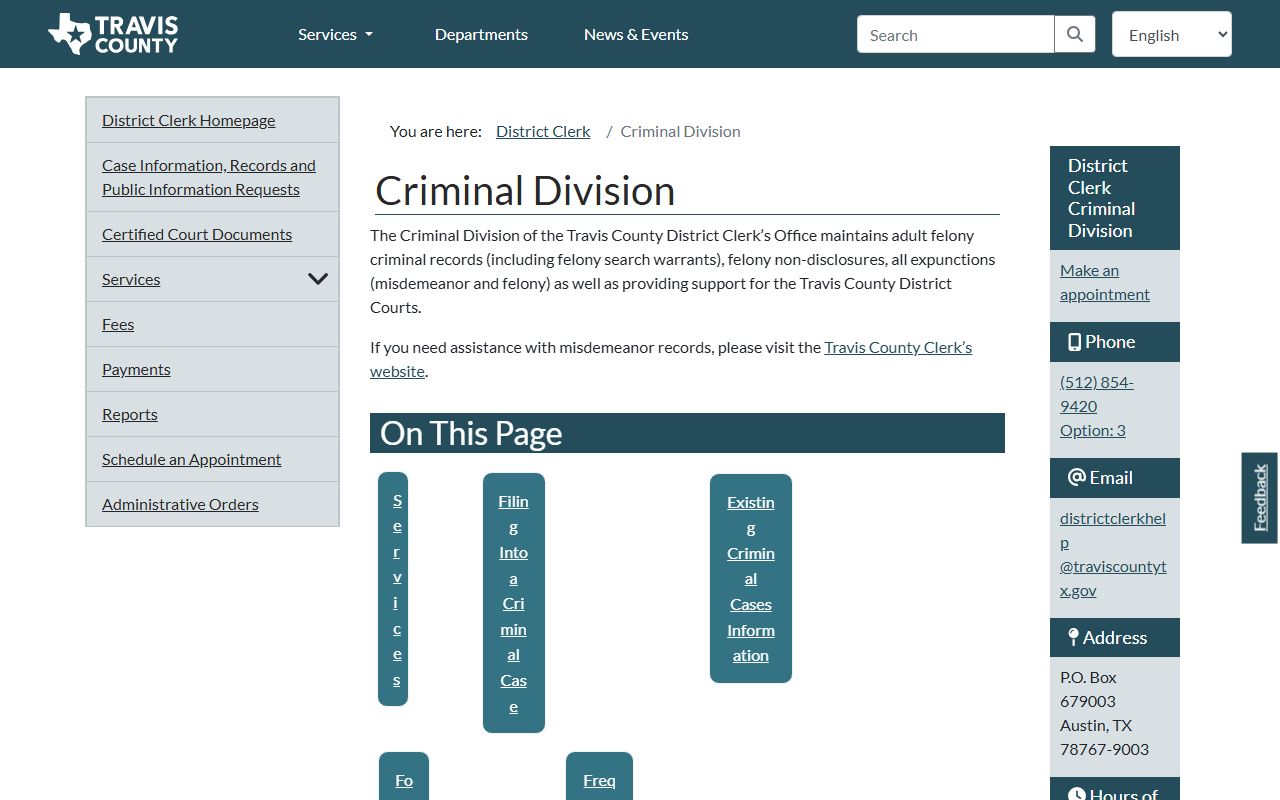
The District Clerk splits its work into divisions, and each one keeps a different set of records. The Criminal Division maintains felony records, felony search warrants, felony nondisclosures, and all expunctions, both misdemeanor and felony. It issues arrest warrants, commitments, and subpoenas and prepares criminal judgments and appeal records. The Criminal Division page details those responsibilities.
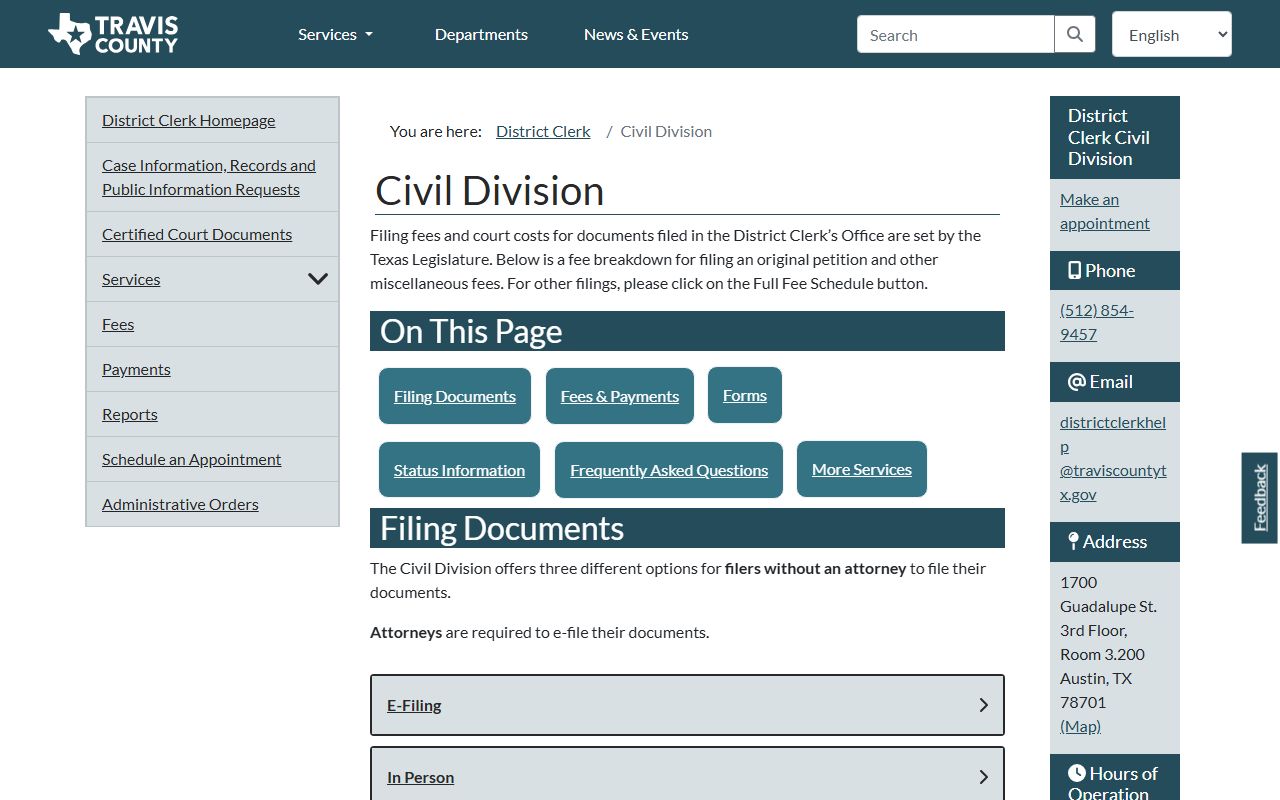
The Civil Division handles tort, contract, real estate, consumer, tax-collection, and state administrative-agency appeal files, and it publishes filing methods and a current fee table. The Civil Division page covers filing and copy fees.
The Family Division keeps divorce, child support, custody, adoption, family protection, and name-change cases. Because Austin is the state capital, the Civil Division also receives appeals of nearly all state administrative-agency rulings, which is unusual for a county clerk.
How to Search and Request District Clerk Records
Public district-court records are available for free online viewing through the Travis County Odyssey Portal. The District Clerk lists coverage of family and civil cases from 2006 to the present and criminal cases from 2008. Official, certified, and authenticated physical copies, though, require a paid request. You can submit a request online, by mail, or in person, with civil and family records at 1700 Guadalupe and felony records at the Gault Annex. The case information and records page lists every request method.
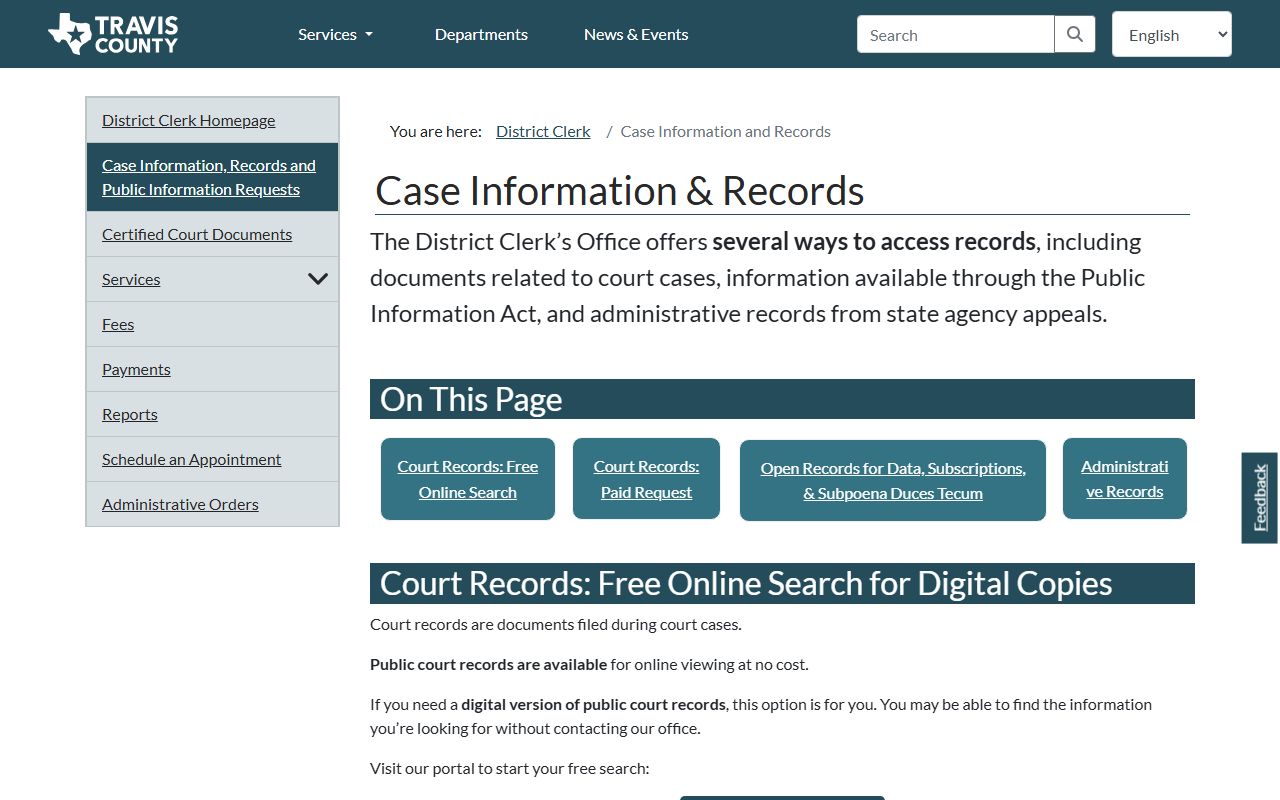
That page also separates two request types. Court-file records use the court-record request route, while data, subscriptions, subpoenas duces tecum, and non-case information use a separate public-information path. Mailed requests go to the District Clerk, Records Request, P.O. Box 679003, Austin, TX 78767. For the full portal walkthrough, see court records.
Coverage Years and Online Viewing
Before you assume a case is missing, check the coverage dates. District-court records are viewable free through the Odyssey portal, but the online history does not reach back forever. The District Clerk lists family and civil cases online from 2006 to the present and criminal cases from 2008. An older case may show only an index entry, or it may require a request to the clerk rather than an online view. Document images can also lag the index, so a recent filing may not show a scanned image right away.
Online viewing is free, but a printout from the portal is not an official copy. For anything a court, agency, or employer will accept, you need a certified copy from the District Clerk. The portal is the place to find the cause number and confirm the case exists; the clerk is the place to get the certified record. For the portal walkthrough and search fields, see the court records page.
Open Records vs Court File Requests
The District Clerk handles two different kinds of requests, and choosing the right one keeps your request from stalling. A court-file record, such as a petition, judgment, or decree, uses the court-record request route through the records request form. A request for data, a subscription, a subpoena duces tecum, or non-case information uses a separate public-information path. Mixing them up sends a request to the wrong queue and slows it down.
Public-information requests can be submitted online, by email, by mail to Attn: District Clerk PIA, P.O. Box 679003, Austin, TX 78767, or in person at 1700 Guadalupe, 3rd Floor. Court-file requests follow the certified-copy steps below. This split mirrors the broader Texas framework, where court records and government records follow different rules, as explained on the public records page.
How to Request a Certified Copy
A certified copy is the version a court, agency, or employer will accept, and an online printout is not certified. The steps below get a certified copy from the District Clerk.
- Find the cause number and party names through the Odyssey portal.
- Complete the District Clerk Court Records Request Form, linked from the records page.
- Submit the request online, by mail to P.O. Box 679003, or in person.
- Pay the certified-copy fee and any search fee due.
- Pick up the copy or wait for it by mail.
For confidential case records, the District Clerk releases them in person only to the assigned attorney or a party with proper ID, so bring identification.
Records Request Form Fields
A clear request moves faster and costs less, because a specific search takes less staff time. The District Clerk request form collects the details below, documented from the official form and page.
| Field | Required | Notes |
|---|---|---|
| Requestor name and contact | Yes | Email or phone for the response |
| Case type | If known | Civil and family, or criminal |
| Cause number | Recommended | Codes include D-1-GN, D-1-FM, D-1-DC, D-1-EX |
| Party names | Recommended | Include aliases if searching by name |
| Document requested | Yes | Such as a final judgment or certificate of divorce |
| Copy type | Yes | Plain, certified, authenticated, or exemplified |
| Delivery method | Yes | Online, email, mail, or in person |
A signature is generally required on a submitted form, and payment is due if copies are produced.
Travis County District Clerk Fees
The District Clerk publishes a fee schedule for searches, copies, and certificates. Credit-card payments carry a non-refundable 3 percent convenience fee with a $3 minimum, and a fee-waiver path exists for those who qualify. The District Clerk resources page lists the current fees.
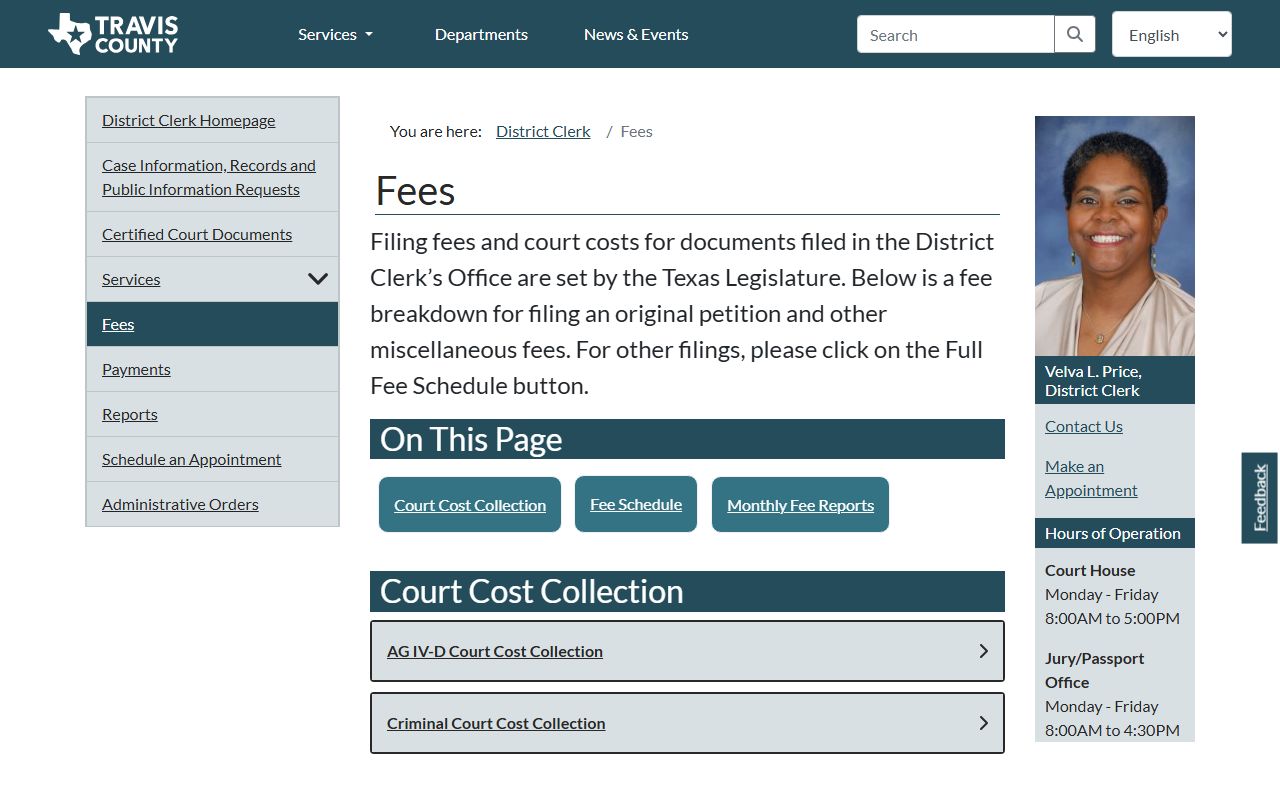
The common charges are below.
| Item | Amount |
|---|---|
| Records search per cause, name, or item | $5 |
| Paper copy per page | $1 |
| Certified copy | $5 per document |
| Certificate of divorce | $10 |
| Certificate of name change | $10 |
| Expunction petition | $350 |
| Nondisclosure petition | $350 |
| 2026 civil base filing fee | $350 |
A Statement of Inability to Afford Payment of Court Costs may be filed by those who cannot pay.
E-Filing and Online Filings
Texas requires attorneys to e-file civil and criminal documents, and the District Clerk directs filers to eFileTexas, the statewide Tyler eFile system. Self-represented parties may also e-file, or they can use in-person and mail routes depending on the document type. Payment methods include personal and business checks, cashier's checks, money orders, credit cards, LegalEase, and direct draft.
A 2026 civil suit carries a base filing fee of $350, made up of a local consolidated fee and a state consolidated fee. For the family-law side, including the 60-day divorce waiting period, see marriage and divorce records. For hearing scheduling, see court dockets. Self-represented divorce filers should also note the mandatory case review at the Travis County Law Library before a final hearing, a step unique to the family process.