
The Federal Court for Travis County
Travis County falls in the Austin Division of the U.S. District Court for the Western District of Texas. The Western District is a large court that serves more than 7 million residents across central and west Texas, with Austin as one of its divisions. Federal district courts handle federal criminal cases, civil-rights and constitutional litigation, federal-question and diversity civil cases, habeas and prisoner petitions, and federal tax and regulatory matters. The Western District of Texas site is the official starting point.
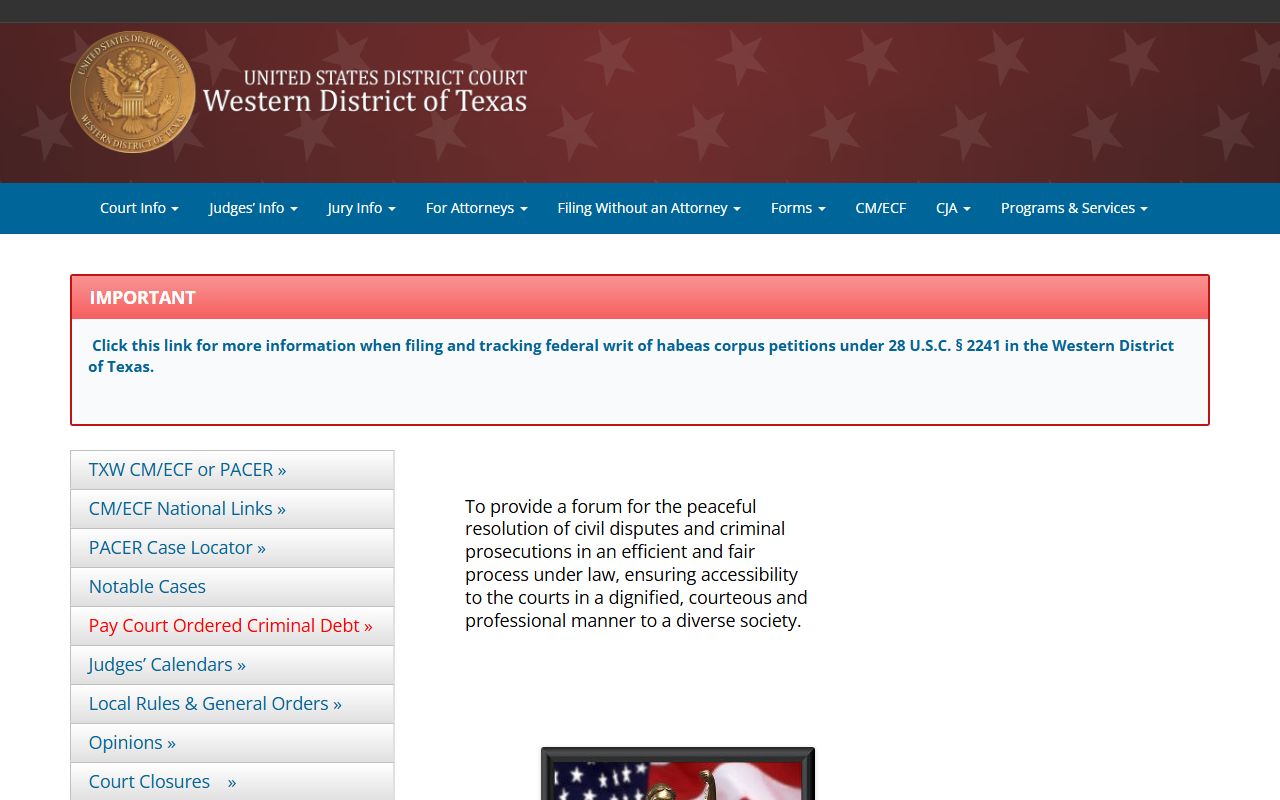
The Austin federal courthouse hears these cases, and the court site lists Austin among its locations along with electronic-access links. This is a separate system from the Travis County courts, with its own judges, clerk, and rules.
Types of Federal Cases in Travis County
Federal court handles a different set of cases than the Travis County courts, and knowing the categories helps you decide whether a matter is federal at all. Federal criminal cases cover offenses charged under federal law, such as certain drug, firearm, fraud, and immigration crimes. Federal civil cases include civil-rights and constitutional claims, federal-question disputes that turn on a federal statute, and diversity cases between parties from different states above a dollar threshold. The court also hears habeas and prisoner petitions, federal tax and regulatory matters, and other cases within federal jurisdiction.
Bankruptcy is its own federal track, handled by a separate bankruptcy court. None of these are Travis County records, so a search for them never starts at the county portal. A useful test is to ask who brought the case and under what law. If a federal agency or the U.S. Attorney is involved, or the claim rests on the U.S. Constitution or a federal statute, the record is almost certainly federal.
PACER and CM/ECF for Federal Cases
Federal case records are searched through PACER and CM/ECF, not the county portal. CM/ECF is the court's electronic case-filing system, and PACER is the public access service that lets you read federal dockets and documents. The Western District links its CM/ECF login, the national CM/ECF links, and the PACER Case Locator. PACER is account-based and charges per-page fees, subject to current judiciary fee rules and quarterly fee waivers. The Western District CM/ECF page provides the access links.
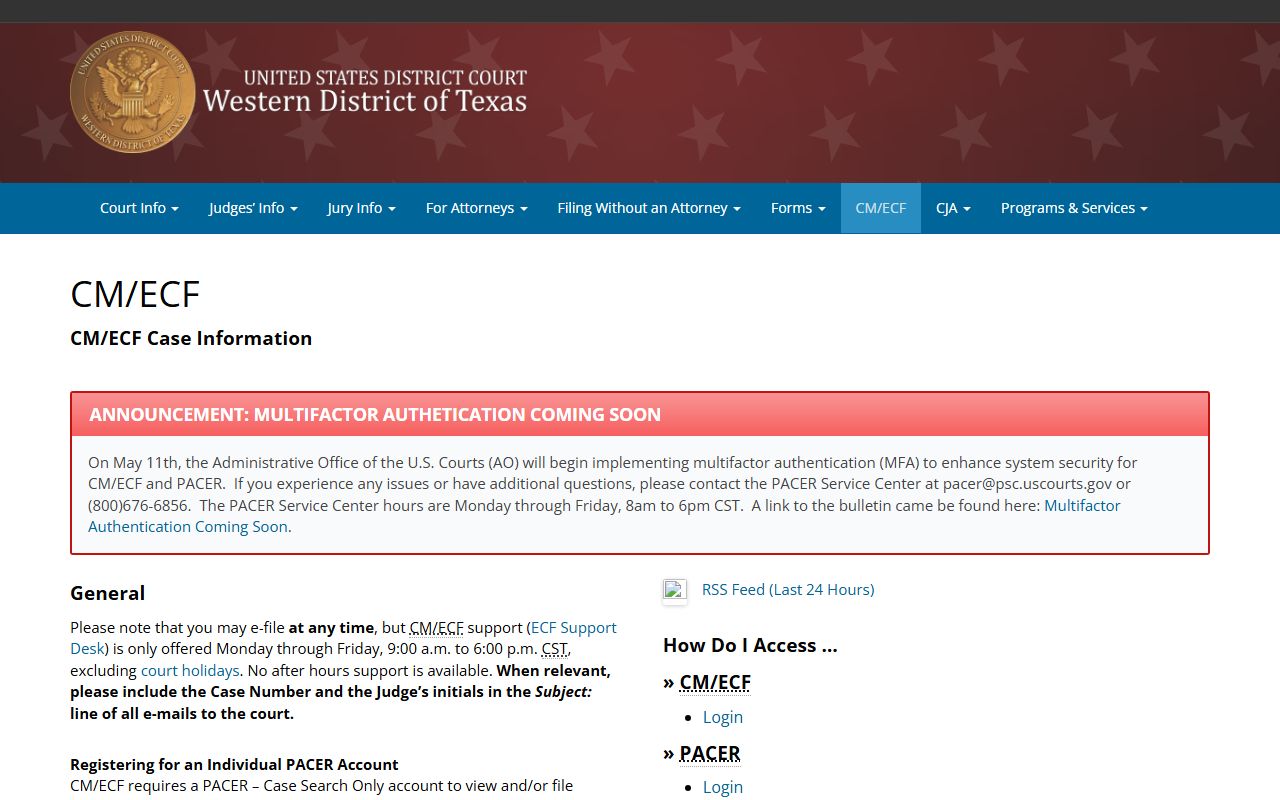
If you do not want a PACER account, a free alternative for many opinions and dockets is CourtListener, though it is not the official record and may miss filings. Some federal clerk offices also offer public access terminals. For the county-side portal, see court records.
Searching a federal case is a different routine than a county lookup. The steps below outline the usual path.
- Decide whether the case is district, bankruptcy, or appellate, since each uses a different system.
- Set up a PACER account if you do not have one, or use a public access terminal at the clerk's office.
- Use the PACER Case Locator to find the case across federal courts, or go straight to the Western District CM/ECF.
- Search by party name or case number, then open the docket sheet.
- Be aware of per-page fees, which are subject to current judiciary rules and quarterly waivers.
Federal Bankruptcy Court
Bankruptcy is federal, so Travis County bankruptcy cases are not county records. They run through the U.S. Bankruptcy Court for the Western District of Texas, which is separate from both the district court and the county clerks. Bankruptcy filings use their own CM/ECF and PACER access, distinct from the Travis County Odyssey system. The Western District Bankruptcy Court site is the official source.
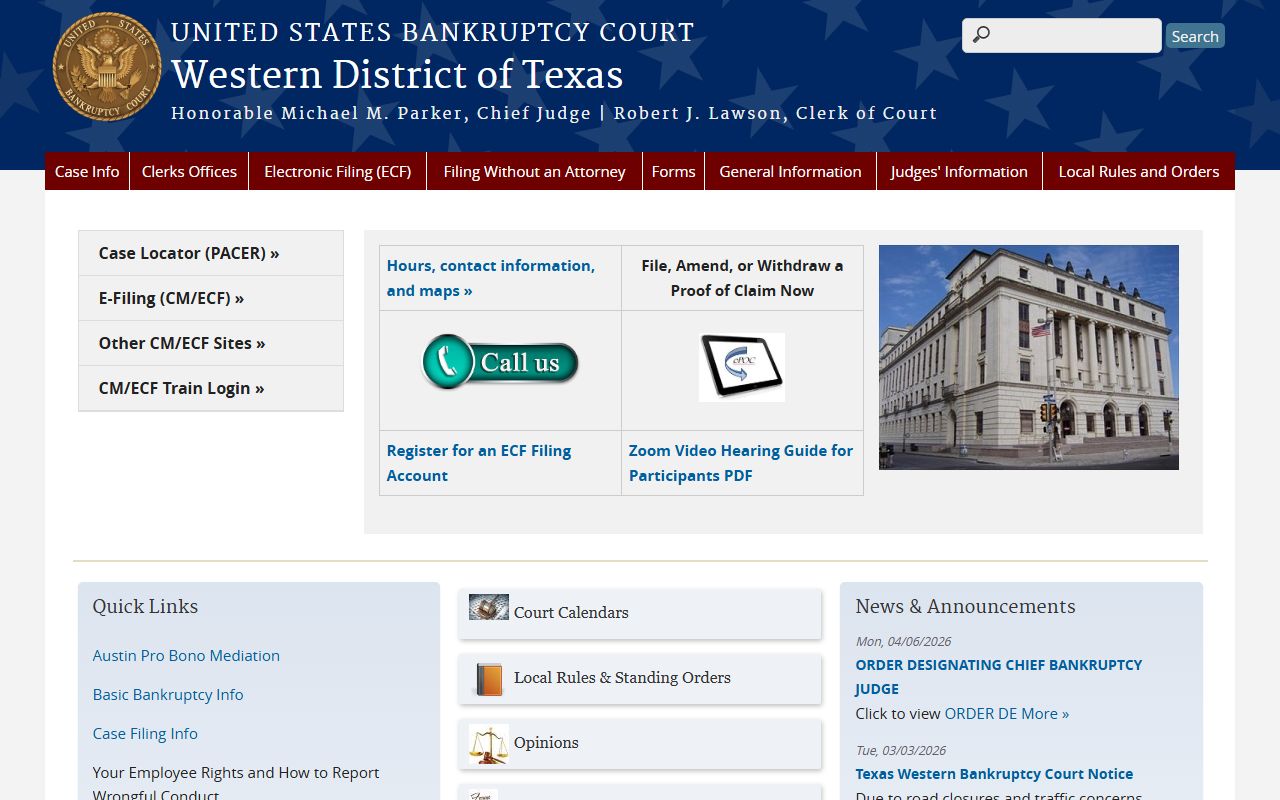
So a bankruptcy search never starts at the county portal. It starts at the bankruptcy court and PACER. This trips up people who expect all of a person's cases to appear in one place, when federal and county records are kept entirely apart.
The U.S. Attorney for the Western District
Federal criminal cases in Travis County are prosecuted by the U.S. Attorney's Office for the Western District of Texas, the federal counterpart to the local District Attorney. The office serves the same broad district that includes San Antonio, Austin, and El Paso. The U.S. Attorney for the Western District page describes the office and its work.
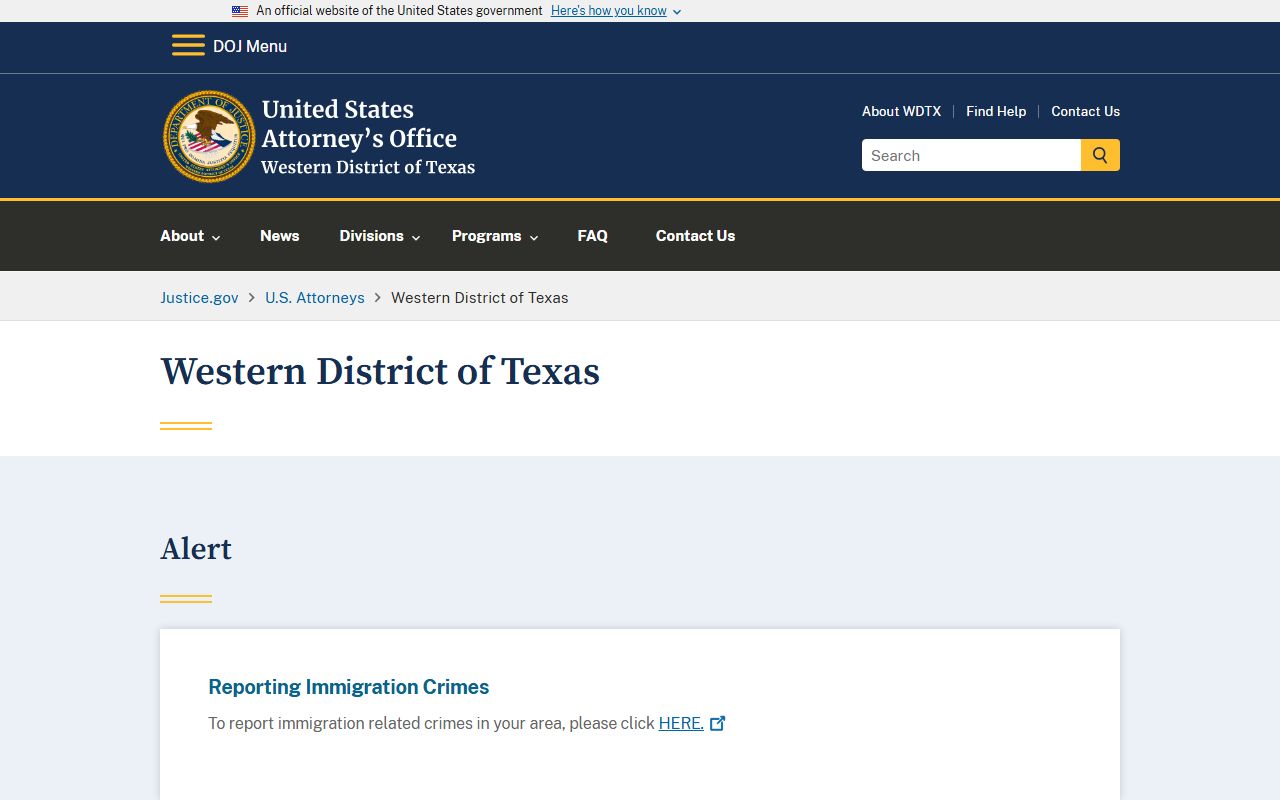
For office locations and how to reach the federal prosecutors, the contact page lists the details. The U.S. Attorney contact page gives the office directory.
The U.S. Attorney shapes federal charges, but the official case record still lives in the federal court file accessed through PACER. Victims and witnesses in a federal case follow the federal victim-services process, which is separate from the Travis County District Attorney's victim services. The two systems run in parallel and do not share a case file.
Federal Public Defender
People facing federal charges who cannot afford an attorney may be represented by the Federal Public Defender. The office has an Austin location, and the federal defender for the district is listed in the office directory. This is the federal counterpart to the county's indigent-defense system, and it is separate from the Travis County Public Defender. The Federal Public Defender Austin office page gives the local contact.
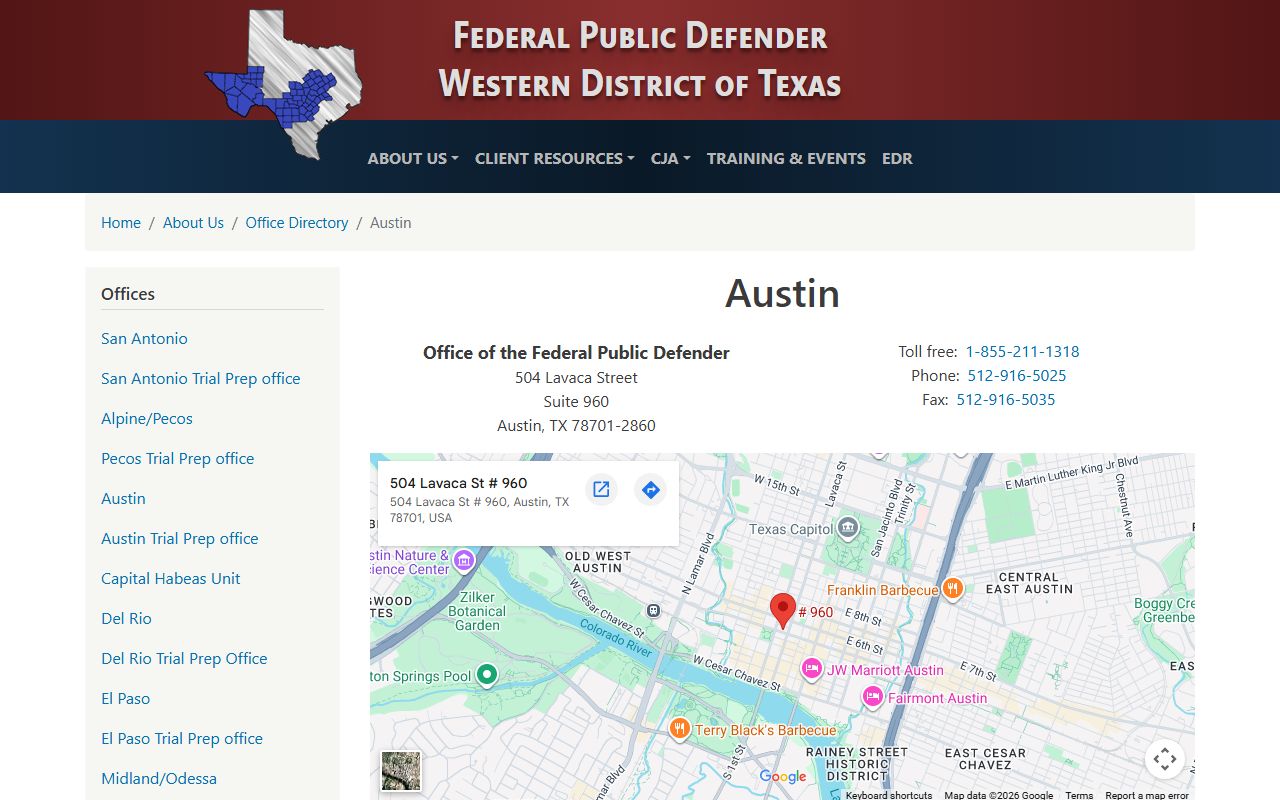
The Austin federal defender office is at 504 Lavaca Street, Suite 960, Austin, TX 78701, with a local line of 512-916-5025 and a toll-free line of 1-855-211-1318. For county-level defense, the Travis County Public Defender is covered on the arrest records page.
Federal Inmate Search
Federal inmates are found through the Bureau of Prisons inmate locator, not the county jail roster or the state prison search. The BOP locator covers federal inmates held from 1982 to the present and searches by name or by a register number. A result shows the name, register number, age, release date, and location. A status of released or not in custody means the person left federal custody, though they may be on supervision.
The BOP search will not show a Travis County jail detainee or a Texas state prisoner, since those are different systems. For the county jail roster, see inmate records, and for the BOP locator alongside state tools, see criminal databases.
The locator also warns that federal release dates can change under First Step Act sentence recalculation, so a projected date is an estimate. If you are tracking a person across systems, a county defendant sentenced on a federal charge moves into BOP custody, while a state sentence sends them to the Texas Department of Criminal Justice instead. Matching the right database to the right sentence avoids the common mistake of assuming a missing name means release. A person can leave one system only to appear in another, and only the controlling agency can confirm a true release.
Federal Appeals From Travis County
Appeals from the Western District of Texas go to the U.S. Court of Appeals for the Fifth Circuit, except for specialized routes such as certain patent or Tucker Act claims that go to the Federal Circuit. This is a separate appellate path from the Texas state courts, where Travis County appeals run to the Texas Courts of Appeals and then to the Texas Supreme Court or Court of Criminal Appeals.
So a federal case and a state case from the same county climb entirely different ladders. The federal appeals records are accessed through the Fifth Circuit and PACER, not through any Travis County system. For the state appeals path, see the District Court page.
Federal Records vs Travis County Records
The simplest way to avoid a wasted search is to know the dividing line. Federal crimes, federal civil-rights and constitutional cases, federal-question and diversity civil cases, and bankruptcy are federal records, found through PACER and the Western District. Felonies under state law, divorce, county civil, probate, and misdemeanors are Travis County records, found through Odyssey and the clerks.
A person can have both a federal case and a separate state or county case, and neither system shows the other. When a search of the county portal comes up empty for a matter you know is federal, the federal court and PACER are the place to look. For the county records framework, see court records and public records.