
Where Marriage and Divorce Records Live in Travis County
The first thing to know is the office split. The County Clerk handles marriage licenses, including the application, the recording, and certified copies after the ceremony. The County Clerk also records informal or common-law marriage declarations. The District Clerk's Family Division handles the court side of family life, including divorce, child support, custody, adoption, family protection, and name-change cases. A divorce is a court case with a cause number, while a marriage license is a recorded document.
This means a marriage record search and a divorce record search start in different places. For a marriage license, you go to the County Clerk. For a divorce decree, you go to the District Clerk or search the court portal. Both offices feed the same Odyssey court search for case data, but copies come from the office that holds the file. The County Clerk and District Clerk pages cover each office in full.
Travis County Marriage License Office
The Travis County Clerk issues marriage licenses, and the standard license fee is $80. Texas law sets a waiting period before the ceremony unless an exemption or waiver applies, so couples should follow the Clerk's current instructions. After the ceremony, the completed license must be returned to the County Clerk within 30 days. The Clerk's page also links the judges who perform ceremonies and the absent-applicant process for a partner who cannot appear in person.
The County Clerk marriage license page is the official source for the current process.
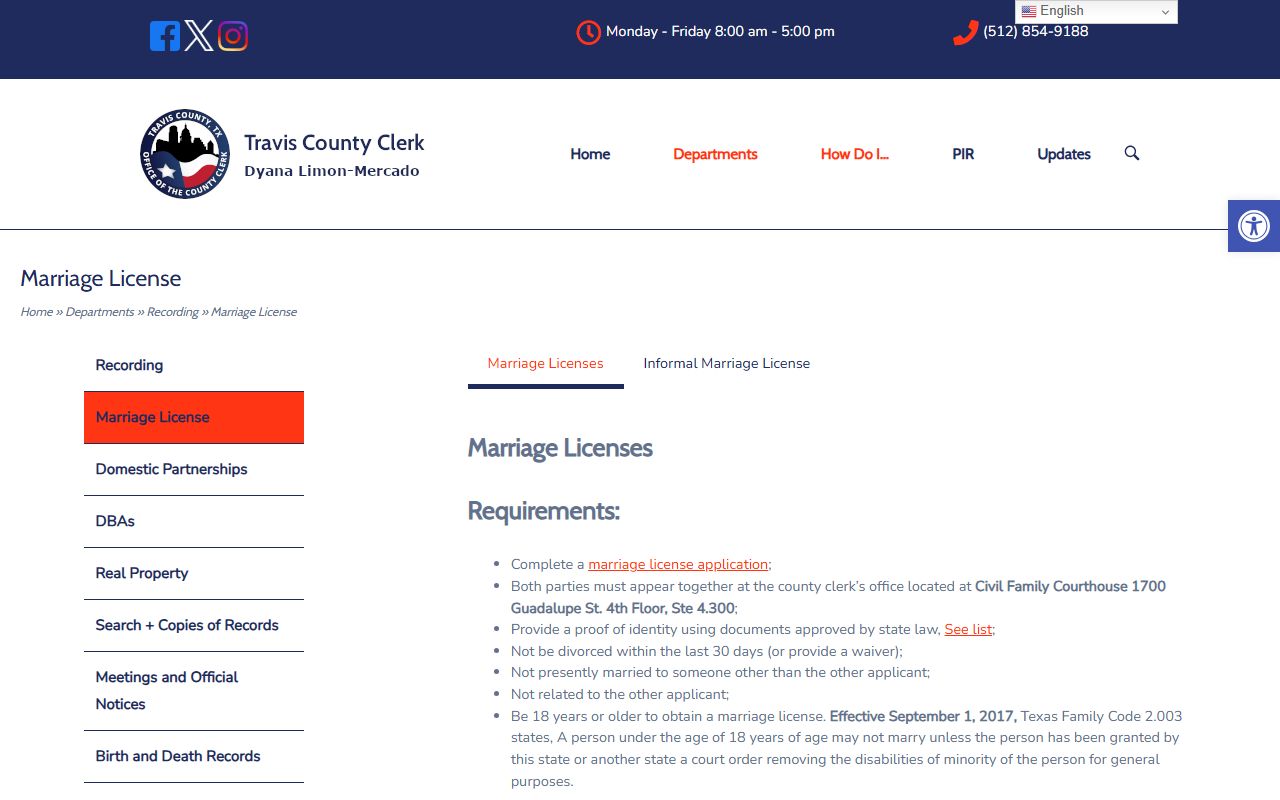
That page covers the fee, the return deadline, and the absent-applicant packet. Check it for the latest ID, waiting-period, and appointment details before you go.
How to Apply for a Marriage License
Applying is straightforward once you know the steps. Both applicants usually appear together with valid ID, unless one uses the absent-applicant process. The steps below follow the County Clerk's guidance.
- Review the County Clerk marriage license page for current rules.
- Complete any online application or pre-application the Clerk offers.
- Both applicants appear with valid ID, or use the absent-applicant packet.
- Pay the $80 standard license fee.
- Observe the Texas waiting period unless exempt or waived.
- Have the ceremony performed by an authorized officiant or judge.
- Return the completed license to the County Clerk within 30 days.
- Request certified copies from the County Clerk once it is recorded.
Marriage License Application Fields
The application collects identity details for both applicants, and the absent-applicant packet adds a notarized affidavit when one partner cannot appear. Texas law requires certain identity data, and some of it is protected from public release. The table below lists the fields documented on the County Clerk forms.
| Field | Required | Notes |
|---|---|---|
| Applicant names | Yes | Full legal name for both applicants |
| Date of birth / age | Yes | Verified against ID |
| Identification | Yes | Government-issued photo ID details |
| Address | Yes | Mailing or residence address |
| Notary (absent applicant) | Conditional | Affidavit must be notarized if a partner is absent |
| Signature | Yes | Applicant or representative signatures |
Statutory identity data such as a Social Security number is collected but is not part of the public record.
Marriage and Divorce Record Fees
Fees differ by office and document. The County Clerk charges the marriage license fee and copy fees, while the District Clerk charges divorce-related certificate and copy fees. The common charges are below; credit-card payments add a fee of $3 under $100 or 3 percent at $100 and up.
| Item | Amount |
|---|---|
| Marriage license (standard) | $80 |
| Certificate of divorce (District Clerk) | $10 |
| Certificate of name change (District Clerk) | $10 |
| Certified copy (District Clerk) | $5 per document |
| Certified copy (County Clerk) | $5 per document plus $1 per page |
| Records search per cause or name | $5 |
A certified copy is the version a court or agency will accept. An online printout from the portal is not certified.
Searching and Copying Divorce Records
Divorce records are District Clerk family records. Divorce petitions are public unless sealed, though child-related details and adoption files carry strong privacy protections. You can search divorce cases in the Odyssey court portal by name or cause number, and you can order copies of a divorce decree through the District Clerk Records Request Form or in person at the Civil and Family Courts Facility. The District Clerk divorce page explains the self-represented process and copy requests.
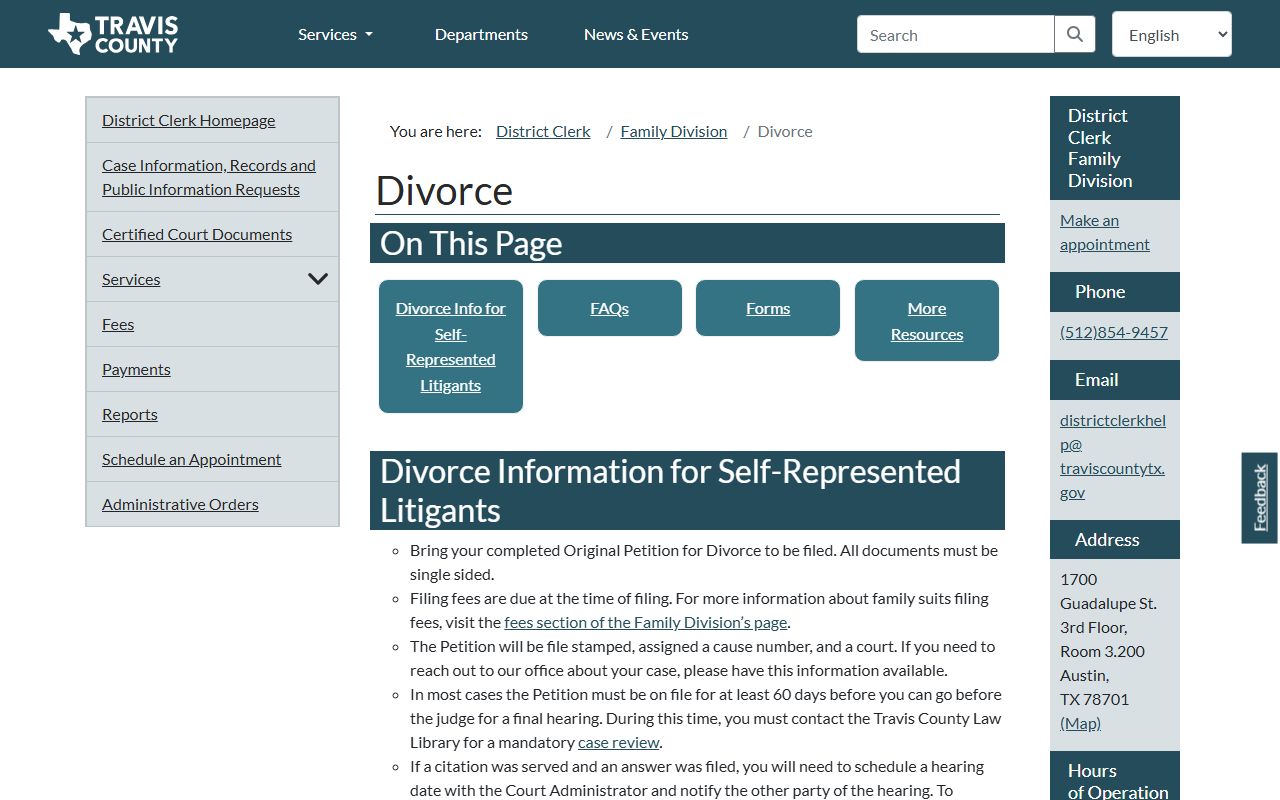
That page also notes that the District Clerk cannot give legal advice or provide divorce forms, and it points self-represented filers to Texas Law Help and the Travis County Law Library. In-person copy requests go to 1700 Guadalupe Street, 3rd Floor, Room 3.200.
The 60-Day Waiting Period and Divorce Process
A Texas divorce is not quick by design. The District Clerk page says that in most cases the Original Petition for Divorce must be on file at least 60 days before a final hearing. Self-represented litigants must contact the Travis County Law Library for a mandatory case review before that final hearing. Contested issues, service problems, and child custody or support can stretch the timeline well beyond the minimum.
The basic path runs from filing to final decree. A filer prepares the petition, pays the fee or files a statement of inability to afford costs, receives a cause number and court assignment, serves the other party, completes the Law Library review if self-represented, waits the 60 days, schedules the hearing through Court Administration, and files the final decree. A Vital Statistics Form VS-165 is filed with the final order, and child-support orders use the Texas State Disbursement Unit. For hearing scheduling, see court dockets.
Certified Copies of Marriage and Divorce Records
Certified copies prove a marriage or divorce for legal, immigration, name-change, or benefits purposes. For a marriage record, request a certified copy from the County Clerk after the license is recorded. For a divorce, request a certified copy of the decree or a certificate of divorce from the District Clerk. Bring the names, the approximate date, and a cause number if you have it, since a specific request is faster and cheaper than a broad search.
Mail and in-person requests both work. The District Clerk accepts requests through its records request form, by mail, or in person, and the County Clerk handles marriage copies through its recording division. Plan for the search fee plus the per-document and per-page copy charges listed above.
Informal and Common-Law Marriage Records
Texas recognizes informal marriage, often called common-law marriage, and Travis County records it through the County Clerk. A couple can sign a Declaration of Informal Marriage, which the County Clerk records much like a license, and that recorded declaration becomes the public proof of the marriage. This is different from a standard license and ceremony, but the recorded document carries similar weight for legal and benefits purposes.
Because an informal marriage can affect property, inheritance, and benefits, people sometimes need a certified copy of the declaration years later. Those copies come from the County Clerk recording division, the same office that handles standard marriage records. The County Clerk page links the recording-related forms for both formal licenses and informal declarations. If a relationship ends, an informal marriage still requires a formal divorce through the District Clerk, just like any other marriage, so the divorce process and the 60-day waiting period apply the same way.
Family Law Self-Help
Many people handle a divorce or name change without a lawyer, and the county supports that. The Travis County Law Library and Self-Help Center is the central resource, and its case review is mandatory for self-represented divorce filers. Texas Law Help offers free statewide forms and instructions for divorce, name change, protective orders, and fee waivers, though it does not file documents for you.
For complex custody, property, or safety issues, legal aid groups such as Texas RioGrande Legal Aid and Volunteer Legal Services of Central Texas can help eligible residents. The clerks themselves cannot give legal advice. For related court files, see court records, and for probate and estate matters, see probate records. Filing through eFileTexas is the standard route for attorneys, and self-represented parties can file electronically or use in-person and mail options depending on the document, so check the current method before you submit.