
How to Search Travis County Court Records
Travis County court records are searched through the Travis County Odyssey Portal. The portal covers case records and documents for the County Clerk, the District Clerk, and the Probate Court. Registration is not required to run a public search. You search anonymously, and the system returns case numbers, party names, case types, and hearing history. Elevated users who sign in may see more detail, according to the official user guide. The portal needs JavaScript and cookies, and it does not work in Internet Explorer.
Before you start, gather what you have. A full name helps. A cause number helps more. Names are entered in Last, First Middle Suffix order, and they are not case sensitive. The county's main courts landing page links the portal along with civil, criminal, probate, and justice court resources.
The official Travis County courts page ties together every record route in one place, from the District Clerk to the Probate Court.
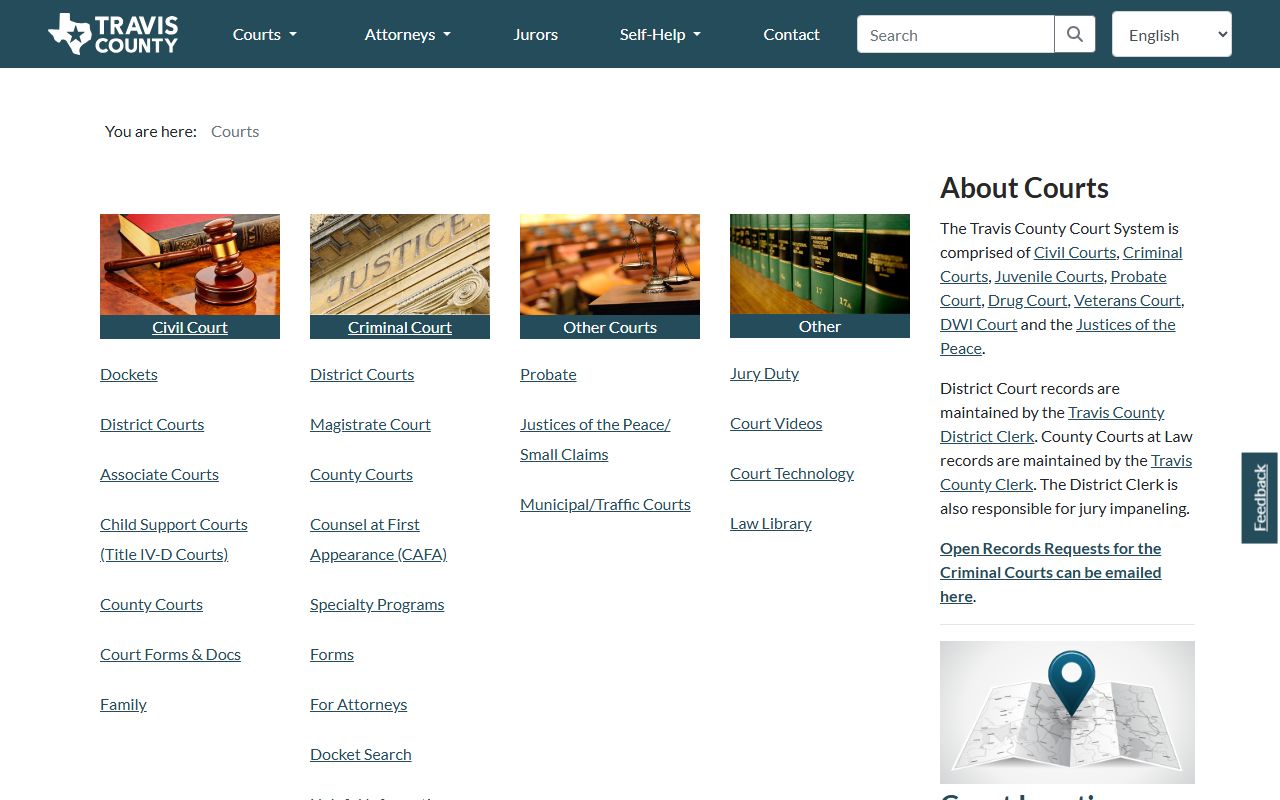
That landing page is the safest first stop because it routes you to the correct clerk before you waste time in the wrong system. Use these steps to run a clean search.
- Open the portal at odysseyweb.traviscountytx.gov and confirm it lists County Clerk, District Clerk, and Probate Court.
- Click Smart Search.
- Enter a case number or a name in Last, First Middle order. For a wildcard, type at least three last-name letters plus an asterisk.
- Open Advanced Filtering Options to pick a clerk, a case type, a date range, or a judicial officer.
- Submit, sort the results, and click a case number to read the docket.
- Request a certified copy from the clerk if you need an official record.
Which Travis County Clerk Has Your Record
Travis County uses a split clerk model, and this trips up many searchers. The District Clerk keeps records for the District Courts and some cases in County Court at Law 4. The County Clerk keeps county civil, probate, misdemeanor, marriage, real property, and recording records. Pick the wrong office and your search comes up empty even when the record exists.
The short rule is simple. Felonies, divorce, and district civil cases are District Clerk records. Class A and B misdemeanors, probate, and marriage licenses are County Clerk records. The table below breaks down the split so you can route your request the first time.
| Office | District Clerk | County Clerk |
|---|---|---|
| Courts served | District Courts; some County Court at Law 4 | County Courts at Law; Constitutional County Court |
| Criminal | Felonies, grand jury, all expunctions | Class A and B misdemeanors |
| Civil and family | District civil, divorce, custody, name change, adoption | County civil, small estates |
| Other records | Felony nondisclosures, juries, passports | Probate, marriage, deeds, DBA, birth and death |
| Phone | 512-854-9457 | 512-854-9188 |
For a deeper look at each office, see the Travis County District Clerk and County Clerk pages. Justice of the Peace and Austin Municipal Court traffic cases sit outside both clerks.
The Travis County Court System
Texas has a broad court structure, and Travis County holds nearly every level of it. At the top are two courts of last resort. The Texas Supreme Court hears civil and juvenile matters. The Texas Court of Criminal Appeals hears criminal matters. Below them, the Courts of Appeals handle intermediate appeals. Travis County cases historically run through the Third Court of Appeals, and many civil suits against the State now route to the statewide Fifteenth Court of Appeals.
Most cases begin in a trial court. District courts are the main trial courts of general jurisdiction. The county's civil district courts have original jurisdiction in divorce, title to land, election contests, and civil matters of $200 or more. County courts at law split into civil and criminal benches. Probate courts handle estates and guardianships. Justice and municipal courts handle the smallest cases.
Case flow: Justice or Municipal Court › County Court at Law › District Court › Court of Appeals › Texas Supreme Court or Court of Criminal Appeals
The Texas Judicial Branch publishes the full Texas court structure chart that this hierarchy follows.
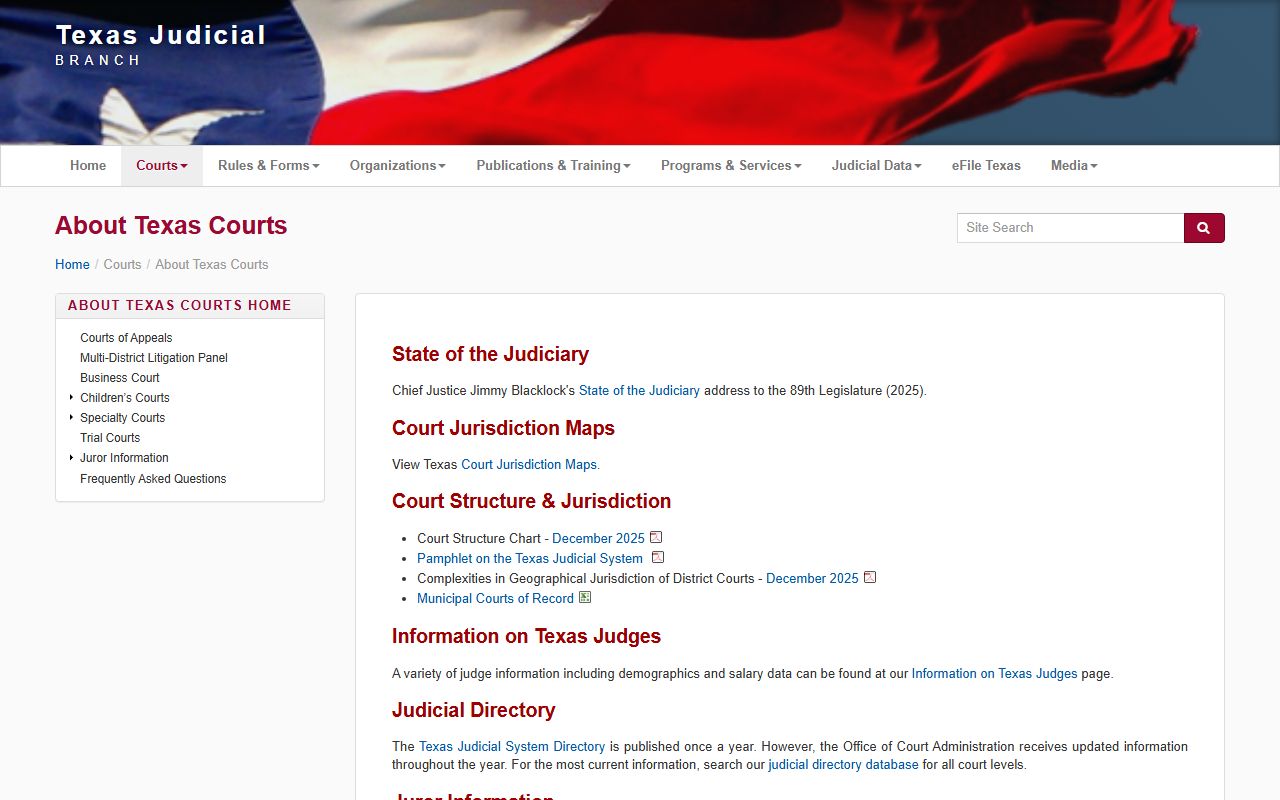
That chart shows how a Travis County case can move from a trial court all the way to a court of last resort. The table below sums up which court hears what.
| Court | Jurisdiction | Case Types |
|---|---|---|
| District Courts | General trial | Felonies, divorce, civil $200 and up |
| County Courts at Law | County level | Class A and B misdemeanors, county civil |
| Probate Courts | Estates and wards | Wills, guardianships, mental health |
| Justice of the Peace | Lower local | Small claims, evictions, traffic, fine only |
| Courts of Appeals | Intermediate appeals | Civil and criminal appeals |
Appeals are explained further on the Texas Courts of Appeals page.
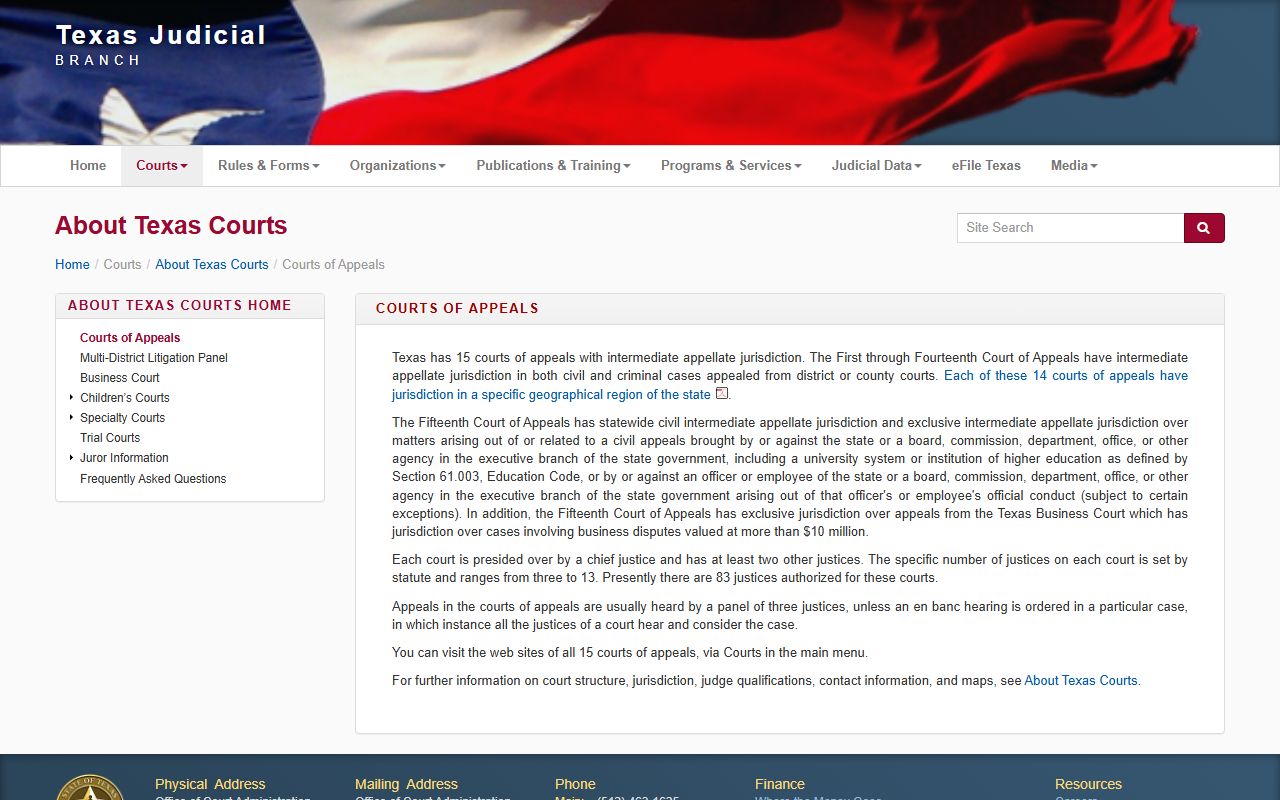
The Fifteenth Court of Appeals is new, and it matters in Austin because so much state-agency litigation is filed here. For the full bench list, see the Travis County District Court page.
Travis County Court Records Search Fields
The Odyssey Smart Search screen accepts more than a name. Knowing the fields lets you cut a long result list down fast. The main field takes a record number or a name. Advanced Filtering Options open extra criteria for parties, cases, and judgments. The county notes a 200-result cap, so narrow your search when a name is common.
| Field Label | Type | Required | Notes / Format |
|---|---|---|---|
| Record Number or Name | Text | Yes | Last, First Middle Suffix; case number wildcard needs 4+ characters |
| Last Name | Text | Party mode | Wildcard needs 3+ letters plus an asterisk |
| Filter by Location | Checkbox | No | All Locations, County Clerk, District Clerk, Probate Court |
| Filter by Date of Birth | Date | No | Useful to split common names |
| Filter by File Date | Date | No | Start and end range |
| Filter by Judicial Officer | Dropdown | No | Narrows to one judge |
For a cause-number search of County Clerk cases, the County Clerk box must be checked. The same portal serves the full Travis County court records and court dockets searches.
Types of Court Records Available in Travis County
Travis County court records cover almost every kind of case. Which court produced the record tells you which clerk holds it and how much of it is public. Civil and family files come from the district and county civil courts. Criminal files split by class. Probate files come from the two probate courts. Traffic cases usually sit in justice or municipal court.
- Criminal records - Felony files at the District Clerk; Class A and B misdemeanors at the County Clerk.
- Civil records - Tort, contract, real estate, tax, and state administrative-agency appeals.
- Family and divorce records - Divorce, child support, custody, adoption, and name change at the District Clerk.
- Probate records - Wills, estates, heirship, and guardianships at the Probate Court.
- Traffic records - Citations heard in justice and municipal courts.
Because Austin is the capital, the District Clerk civil division also receives appeals of nearly all state administrative-agency rulings. That makes Travis County dockets unusually heavy with state cases that started elsewhere.
What Travis County Court Records Show
A case record holds more than a verdict. It tracks a case from the first filing to the final order. The portal shows a case summary, hearings, and events in reverse order, newest first. Online documents may be redacted, and some carry an unofficial watermark. The fields below appear on a typical public case.
| Field | What It Shows |
|---|---|
| Case Number | The court's unique cause number; click it to open the full record |
| Filing Date | The date the case was filed with the clerk |
| Parties | Plaintiff, defendant, petitioner, respondent, and attorneys |
| Case Type | Civil, family, criminal, probate, or misdemeanor |
| Hearings and Events | Settings, motions, orders, and dispositions in date order |
| Disposition | The outcome of a charge or claim |
Social Security numbers and other personal identifiers are blocked on redacted images. A printout is not an official copy.
Travis County Courthouses
Travis County court work is split across several buildings in downtown Austin and Del Valle, not one courthouse. Civil and family hearings run at 1700 Guadalupe. Felony criminal cases run at the Blackwell-Thurman Criminal Justice Center. Probate sits a few blocks away. The Civil and Family Courts Facility page confirms the main civil address and the courts housed there.
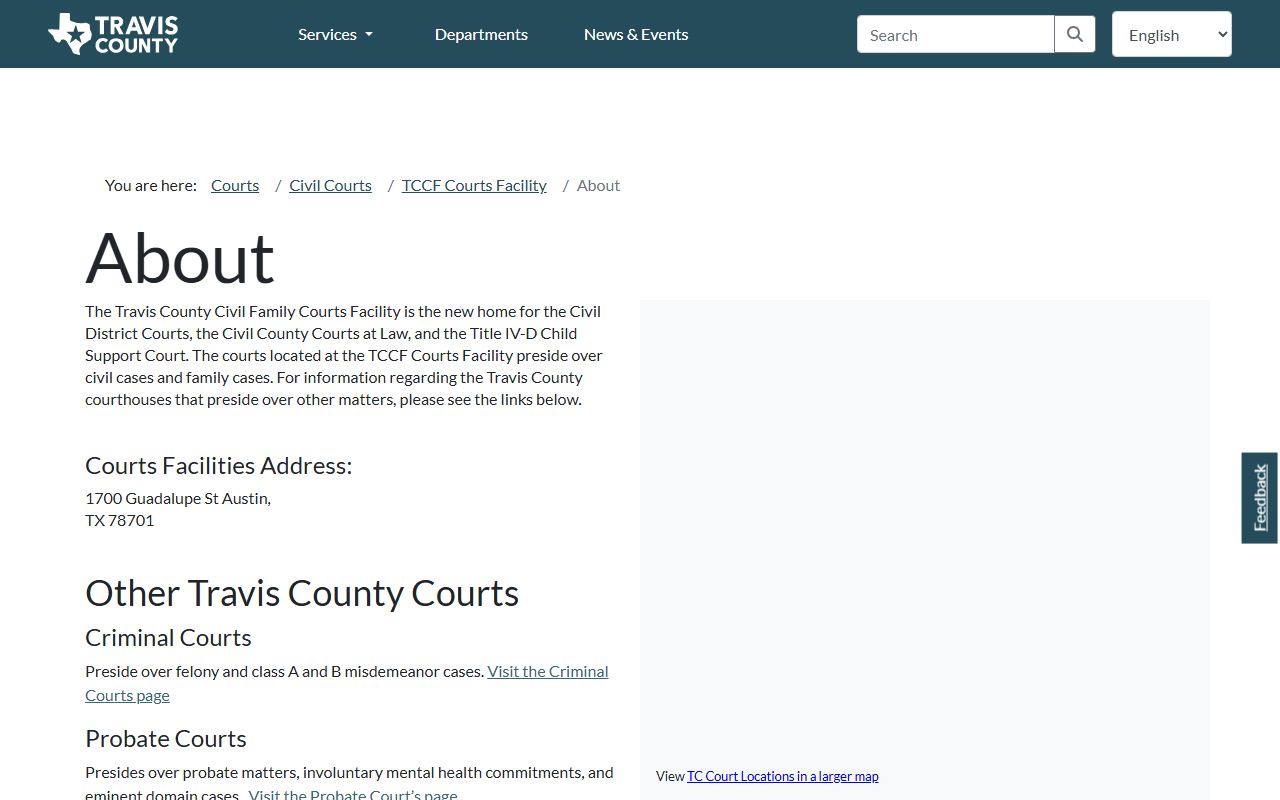
That facility is the active home for the civil district courts, the civil county courts at law, and the Title IV-D child support court. Use the address cards below to reach the right building.
Civil and Family Courts Facility
1700 Guadalupe Street
Austin, TX 78701
512-854-9457
Blackwell-Thurman Criminal Justice Center
509 W. 11th Street
Austin, TX 78701
512-854-9244
Public Access Laws for Travis County Court Records
Texas treats government records and court records differently. The Texas Public Information Act, Government Code Chapter 552, governs records held by county departments. Court case files, though, are reached through the clerks and court rules rather than a generic open-records request. Travis County follows this split on its own pages. Court files use a court-record request, while data and subscription requests use the open-records route.
A handful of statutes shape what you can see and what stays sealed. The Texas Attorney General runs the open government division that rules on disputed requests.

That office issues guidance and rulings when an agency wants to withhold information without a prior determination. The key statutes are below.
Key Statutes:
Texas Government Code § 552.021 - Sets the general right of access to public information held by a governmental body.
Texas Government Code § 552.0035 - Treats judiciary records under court rules, not the standard open-records process.
Texas Code of Criminal Procedure Chapter 55A - Reorganized expunction of criminal records, effective January 1, 2025.
Texas Government Code § 411.081 - Governs criminal-history data and orders of nondisclosure.
Texas Family Code Chapter 58 - Keeps juvenile records confidential except for limited access.
Records That Are Restricted or Confidential
Not every case is open to the public. Some records are sealed by court order. Others are confidential by statute. Juvenile records under Family Code Chapter 58 do not appear in public searches the way adult cases do. Adoption records require a signed order. Expunged records are removed, and nondisclosed records are sealed from public release but stay open to criminal-justice agencies.
To view a sealed record, a person usually must ask the court that sealed it. The District Clerk FAQ says confidential case records can be requested in person only by the assigned attorney or a party with proper ID. Mental-health commitments, grand jury matters, and victim-identifying information are also protected. For the broader framework, see the Travis County public records page.
Specialty Courts in Travis County
Travis County runs a dense set of problem-solving courts. These programs aim to cut repeat offenses by treating the cause, not just the charge. The county's criminal specialty programs include a felony Drug Court, Felony Pretrial Diversion, reentry courts, a DWI Court, and more. Two of the best documented are the Veterans Treatment Court and the Mental Health programs.
The Veterans Treatment Court is led by the Honorable Brad Urrutia in the 450th District Court. It diverts eligible veteran defendants into a 12 to 24 month program for those whose conduct ties to PTSD, a brain injury, military sexual trauma, or another service-related condition. The county's Public Defender's Office backs much of this work.
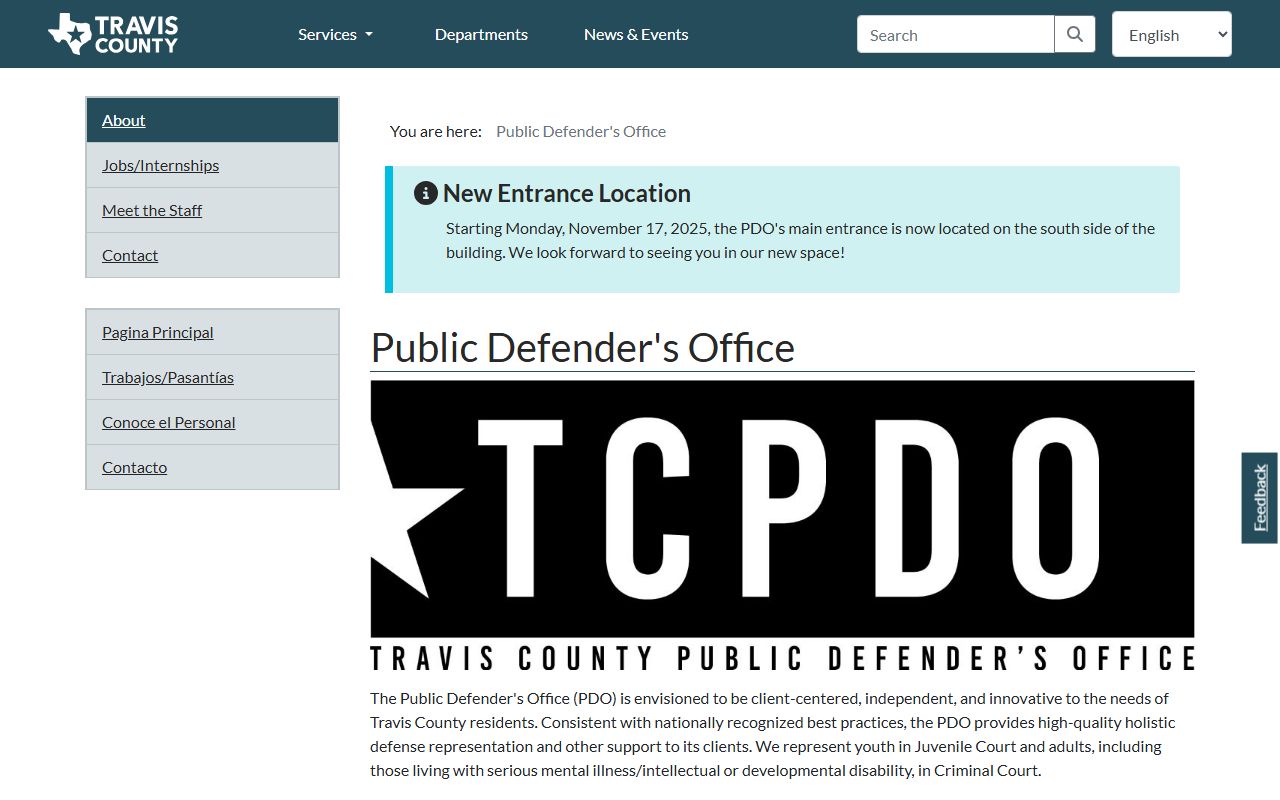
The Public Defender represents adults and youth, including people living with serious mental illness. The Mental Health Division grew out of a program that began in April 2007.

Mental-health dockets and diversion, supervised by the Honorable Leon Grizzard in the Magistrate Court, run 3 to 12 months with treatment, reporting, and regular court dates. Many cases end in dismissal after the person completes the program.
Travis County Sheriff and Jail
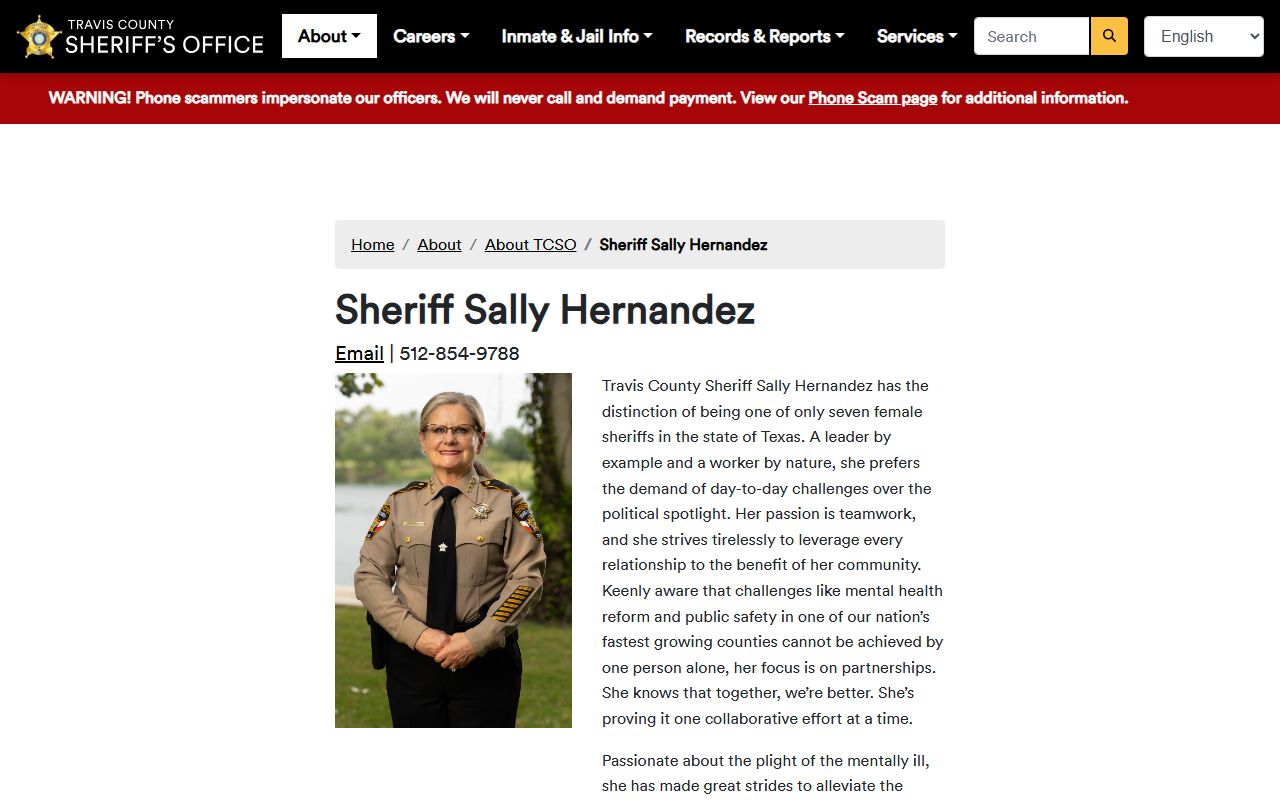
The Travis County Sheriff's Office runs the county jail and the inmate search tool. Sheriff Sally Hernandez was elected in 2016 and serves a jurisdiction of about 1.3 million people across roughly 1,100 square miles. The Corrections Bureau runs two sites with a combined capacity of 2,812. Central Booking processed about 30,000 people in 2023.
The official Sheriff biography page lays out the office's scale and its focus on mental-health reform.
For the jail roster and booking details, see Travis County inmate records. For active warrants, see warrant records. For jail counts and trends, see inmate population.
Marriage, Divorce, and Probate Records
Marriage licenses come from the County Clerk. The standard license fee is $80, and the signed license must return to the Clerk within 30 days of the ceremony. Divorce decrees are District Clerk family records, and in most cases the petition must be on file at least 60 days before a final hearing. Probate runs through two probate courts. For details, see marriage and divorce records and probate records.
Probate cases use terms that confuse many first-time filers. A few are defined here.
- Testator
- The person who made a will.
- Executor
- The person named in a will to settle the estate.
- Intestate
- Dying without a valid will.
- Guardianship
- A court setup to care for a minor or an incapacitated person.
- Conservator
- A person appointed to manage another's affairs or property.
Travis County Court Records Fees
Online viewing through Odyssey is free. Official, certified, and physical copies cost money, and the fee depends on the clerk and the copy type. The District Clerk fee schedule lists the most common charges. Credit-card payments add a non-refundable 3% fee with a $3 minimum.
| Item | Amount |
|---|---|
| Records search per cause or name | $5 |
| Plain copy per page | $1 |
| Certified copy | $5 per document |
| Certificate of divorce | $10 |
| Certificate of name change | $10 |
| Credit card convenience fee | 3% ($3 minimum) |
County Clerk copies follow a separate schedule. Self-service photocopies cost $0.20 per page, and certified copies cost $5 per document plus $1 per page. Full fee tables sit on each District Clerk and County Clerk page.
How to Interpret Travis County Court Records
Court files use shorthand that can mislead a first-time reader. A charge is not a conviction. A disposition is the outcome of a charge or claim. Deferred adjudication means the court held off on a finding of guilt, and the case may be dismissed after the person finishes the terms. District Clerk cause numbers carry letter codes such as D-1-GN for general civil, D-1-FM for family, D-1-DC for criminal district court, and D-1-EX for expunction.
Read the full docket before you draw a conclusion. A single entry rarely tells the whole story.
Accuracy and Record Limitations
Online records can lag behind the courthouse. The County Clerk says case data updates every 24 hours, and newly filed document images take about 72 hours to appear. Hearing dates can change and should be confirmed with the court. If a record looks wrong, contact the clerk that holds it.
Note: Always confirm case details and hearing dates with the District Clerk or County Clerk before you rely on a printout from the public portal.
Courthouse Location and Contact Information
Knowing where to go saves a wasted trip. Civil and family records are downtown at 1700 Guadalupe. Felony records are a few blocks away at the Gault Annex. Two common questions come up again and again.
Where do I go for civil and family records in person?
Visit the Civil and Family Courts Facility, 1700 Guadalupe Street, Room 3.200, Austin, TX 78701, Monday through Friday, 8:00 AM to 4:30 PM. The District Clerk records helpline is 512-854-9457.
Where are felony records kept?
Felony records are at the Gault Annex, 501 W. 11th Street, 2nd Floor, Room 2.300, Austin, TX 78701. The Criminal Court Administration phone is 512-854-9244.
Self-Help and Legal Aid Resources
You do not have to handle a case blind. The Travis County Law Library and Self-Help Center helps people who file on their own. Self-represented divorce filers must contact the Law Library for a mandatory case review before a final hearing. The Travis County Law Library also guides record searches across the clerks and federal courts.
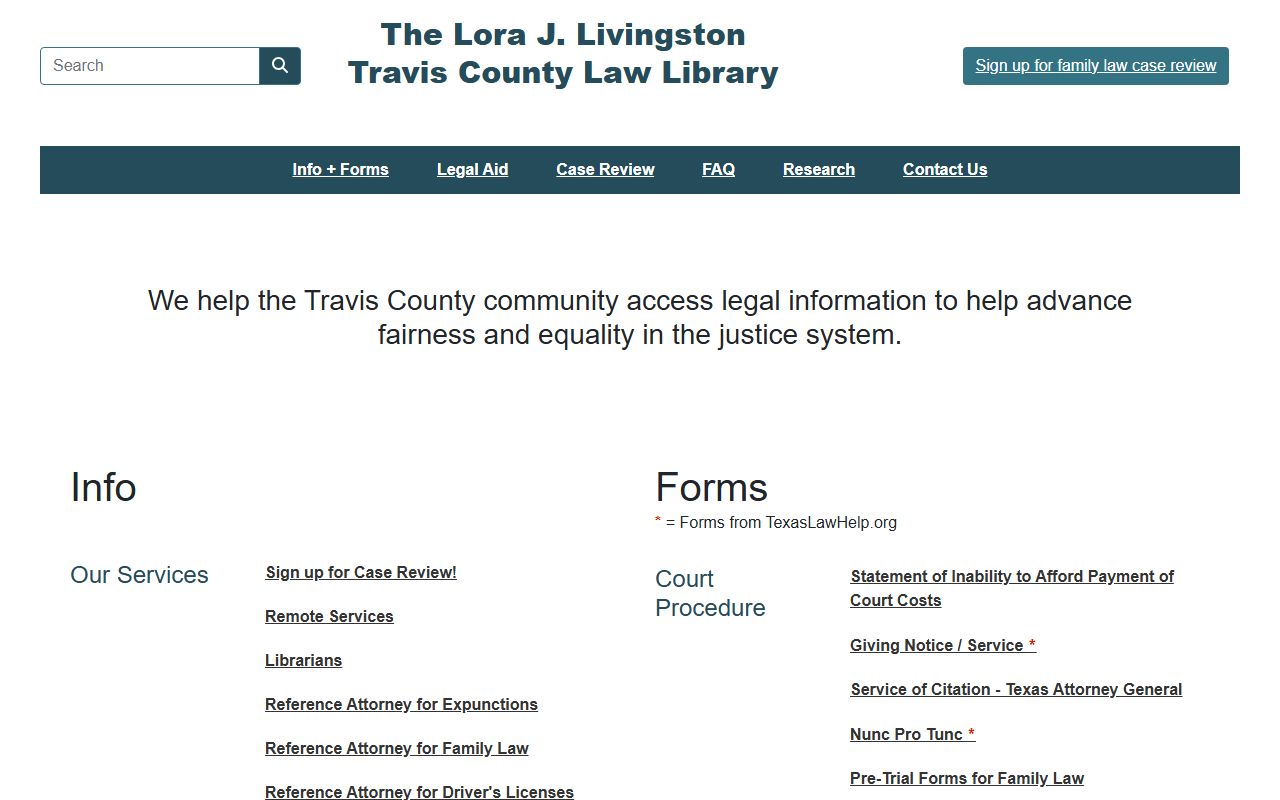
The Law Library explains how to search District Clerk, County Clerk, justice court, and federal case files. Other help includes Texas Law Help, Texas RioGrande Legal Aid, Volunteer Legal Services of Central Texas, and the Austin Bar Association referral service. The clerks cannot give legal advice because their staff are not attorneys.
History of Travis County Courts
Travis County was created in 1840 and named for William Barret Travis. Its court history is tied to Austin's role as the state capital. The downtown courthouse district grew around the Capitol and the Guadalupe and Lavaca street grid. The historic courthouse carries the name of Heman Marion Sweatt, the plaintiff in Sweatt v. Painter, a landmark civil-rights case over segregation at the University of Texas law school that was litigated in Travis County.
Over time the county moved from one historic courthouse to specialized buildings. Criminal cases run at Blackwell-Thurman. Civil and family courts moved to 1700 Guadalupe. Probate sits at 200 W. 8th Street.
Frequently Asked Questions
How do I search Travis County court records online?
Use the Travis County Odyssey Portal. Click Smart Search and enter a case number or a name in Last, First Middle order. Registration is not required for a public search. Use Advanced Filtering Options to choose a clerk, a case type, dates, or a judge. For the full walkthrough, see the court records page.
Are Travis County court records free?
Online viewing through Odyssey is free. Official, certified, or physical copies require a paid request through the District Clerk or County Clerk. Copies printed at home from the County Clerk portal are free but carry an unofficial watermark.
How do I find someone in the Travis County Jail?
Use the Sheriff's Find an Inmate tool, or call jail information at 512-854-4180. The roster shows current custody. More detail sits on the inmate records page.
Where do I get a marriage license?
The County Clerk issues marriage licenses for an $80 fee. The signed license must return within 30 days of the ceremony. See marriage and divorce records for steps and forms.
More answers sit on the Travis County Court Records FAQ page.